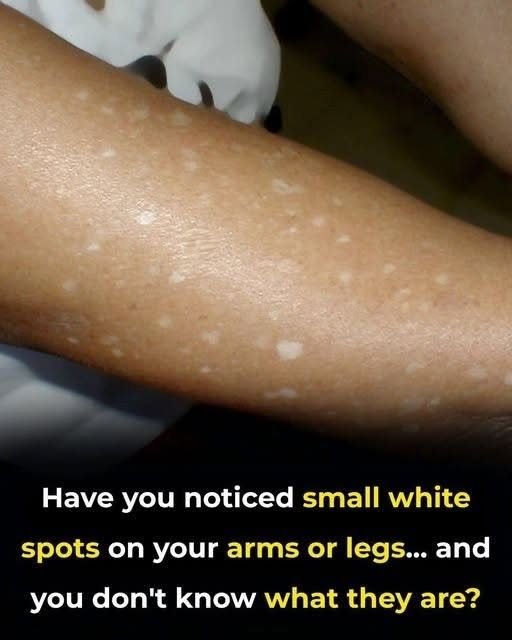
Noticing small white spots on your arms or legs can be unsettling, especially when they appear suddenly or seem to spread. The good news is that in many cases these spots are harmless and linked to common skin conditions, sun exposure, or minor pigmentation changes.
Still, because several different conditions can look similar at first glance, it helps to understand what might be going on—and when it’s worth getting checked by a dermatologist.
1. Idiopathic Guttate Hypomelanosis (Sun-Related White Spots)
One of the most common causes in adults is a condition called idiopathic guttate hypomelanosis (IGH).
These appear as:
- Tiny white or light-colored flat spots
- Usually 1–5 mm in size
- Most common on sun-exposed areas like arms and legs
- More frequent with age
Why it happens
IGH is strongly linked to long-term sun exposure. Over time, UV radiation can reduce melanin production in small patches of skin, leading to permanent but harmless light spots.
Is it dangerous?
No. It’s purely cosmetic and does not turn into anything serious.
2. Vitiligo (Loss of Pigment in Patches)
A more widely known cause of white patches is Vitiligo.
Vitiligo occurs when the immune system attacks pigment-producing cells (melanocytes), leading to smooth, well-defined white patches.
How it looks
- Sharply defined white patches
- Can grow or spread over time
- Often appears on hands, arms, feet, and face
- May be symmetrical on both sides of the body
Key point
Vitiligo is not contagious and not physically painful, but it can be emotionally distressing for some people.
3. Tinea Versicolor (Yeast Overgrowth on Skin)
Another common cause is a superficial fungal condition caused by an overgrowth of yeast called Tinea versicolor.
Appearance
- Small white, pink, or light brown patches
- Fine scaling or dryness
- More noticeable after sun exposure (affected areas don’t tan)
- Often affects upper arms, chest, neck, and sometimes legs
Why it happens
This yeast is normally present on the skin, but heat, humidity, sweating, or oily skin can trigger overgrowth.
Treatment
Usually treated easily with antifungal creams, shampoos, or washes.
4. Pityriasis Alba (Common in Children and Teens)
This mild skin condition often appears as:
- Pale, slightly scaly patches
- Most common on face, arms, and upper body
- More visible after sun exposure
It’s often linked to dry skin or mild eczema and tends to fade over time.
5. Keratosis Pilaris (Sometimes with Light Patches)
Keratosis pilaris is a very common condition caused by keratin buildup blocking hair follicles.
Typical signs:
- Rough “chicken skin” texture
- Small bumps, often on upper arms and thighs
- Occasionally lighter patches around affected areas
It’s harmless and often improves with moisturizing and gentle exfoliation.
6. Milia (Tiny White Cysts)
Milia are tiny, firm white bumps caused by trapped keratin under the skin.
Key features:
- Small white or pearly bumps
- Common on face but can appear elsewhere
- Not itchy or painful
They often go away on their own but sometimes require removal by a professional.
7. Post-Inflammatory Hypopigmentation
After skin injury or inflammation (like eczema, cuts, insect bites, or burns), the skin may heal with lighter patches.
What it looks like:
- Irregular lighter spots
- Appears where skin was previously irritated
- Usually improves slowly over time
When Should You Worry?
Most small white spots are harmless, but you should consider seeing a dermatologist if:
- The spots are rapidly spreading
- They have sharp borders and are increasing in number
- There is itching, pain, or scaling that doesn’t improve
- You suspect an underlying condition like vitiligo or fungal infection
- The diagnosis is unclear
How Doctors Diagnose Them
A dermatologist may use:
- Visual examination
- Wood’s lamp (UV light) test
- Skin scraping (for fungal causes)
- Rarely, a skin biopsy
Final Thoughts
Small white spots on arms and legs are usually not dangerous, and many are related to sun exposure, mild skin conditions, or temporary pigment changes. The key is noticing the pattern: whether the spots are changing, spreading, or staying stable.
If anything looks unusual or persistent, a quick check with a dermatologist can provide clarity and peace of mind.