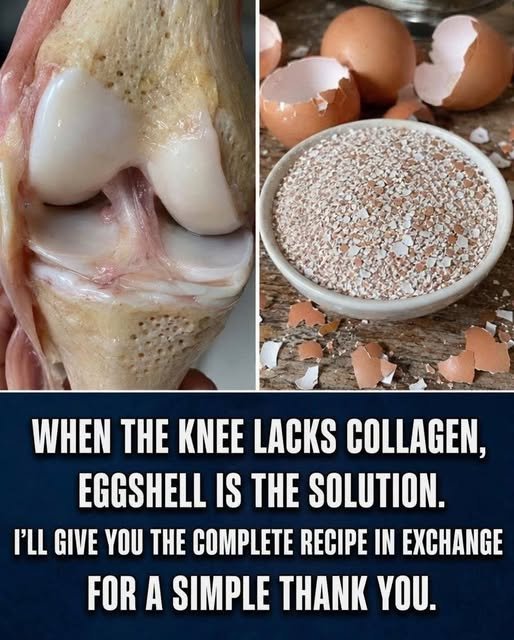
“Eggshells Are a Lifesaver for Knee Collagen Loss” — A Popular Claim That Doesn’t Hold Up
Scroll through social media long enough and you’ll eventually see it:
“When your knees lose collagen, eggshells can rebuild everything.”
It sounds simple, almost old-fashioned and natural—like something passed down through generations. But when you look at what’s actually happening inside the knee joint, the story becomes a lot less magical.
What people mean by “knee collagen loss”
When someone says their knee is “losing collagen,” they’re usually talking about cartilage wear and tear, often linked to conditions like osteoarthritis.
Cartilage is the smooth, cushioning tissue that helps your knee move without pain. It does contain collagen, but it doesn’t just “rebuild itself” from random dietary sources overnight.
Once it starts breaking down, the process is slow and complex—not something a single food can instantly reverse.
Where eggshells enter the story
Eggshells are mostly made of calcium carbonate, the same type of mineral found in some bone health supplements.
This is where the confusion starts.
People assume:
- Calcium = bones
- Bones are near joints
- Therefore, calcium fixes joints
But joints aren’t just bone. They’re a system of cartilage, ligaments, synovial fluid, and connective tissue. Calcium alone doesn’t rebuild cartilage or restore collagen.
What about eggshell membrane?
Some supplements use the thin inner layer of the eggshell, called the eggshell membrane, which contains small amounts of proteins like collagen, elastin, and glycosaminoglycans.
That sounds promising—but here’s the reality:
- It is processed and purified, not eaten as crushed shells
- Research is still limited
- Any benefits are modest and supportive, not restorative or “healing”
So even in its refined form, it’s not a miracle cure.
Why the “eggshell cure” idea became popular
This kind of claim spreads easily because it checks a lot of psychological boxes:
- It sounds natural and traditional
- It uses a familiar kitchen ingredient
- It offers hope for a painful problem
- It promises an easy, low-cost solution
But joint degeneration doesn’t respond to shortcuts. It responds to long-term care.
What actually supports knee health
If the goal is healthier, more comfortable knees, the evidence consistently points in a different direction:
1. Strengthening the muscles around the knee
Strong thighs and hips reduce pressure on the joint itself.
2. Staying active (but smart about it)
Low-impact movement like walking, cycling, or swimming helps keep joints functional.
3. Managing body weight
Even small reductions in weight can significantly reduce knee stress.
4. Medical guidance when needed
Physiotherapy, medications, or other treatments may be necessary depending on severity.
5. Balanced nutrition
Protein, vitamin D, calcium, and overall diet quality support general bone and joint health—but don’t “rebuild cartilage” on demand.
The bottom line
Eggshells are not a lifesaver for knee collagen loss. At best, they’re a source of calcium in a limited sense, and even processed eggshell membrane supplements only offer mild, supportive effects—not reversal of joint damage.
Knee health isn’t restored through a single ingredient. It’s built through movement, strength, consistency, and proper medical care when needed.
If you want, I can turn this into a series of myth-busting posts (like “turmeric cures joint pain” or “gelatin restores cartilage overnight”) in the same blog style.