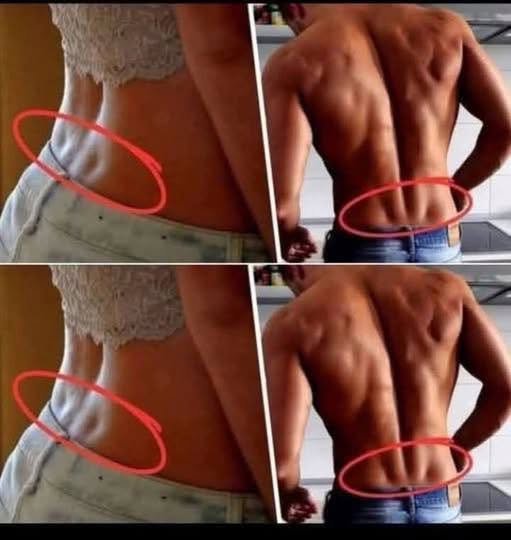
Have you ever noticed two small indentations on your lower back, just above your buttocks? These symmetrical “holes” or dimples often spark curiosity online, with viral posts claiming they reveal hidden health secrets or special abilities.
So, what do these two dimples actually mean? The answer is much simpler—and more interesting—than many social media posts suggest.
What Are These Lower Back Dimples?
The small indentations are commonly known as dimples of Venus in women and dimples of Apollo in men. They are natural anatomical features located where the skin is attached to the underlying pelvis by short ligaments.
Not everyone has them. Whether they appear depends largely on your genetics and body structure.
Why Do Some People Have Them?
These dimples are usually inherited and are determined by:
- Your bone structure
- The way ligaments connect your skin to the pelvis
- Your body fat distribution
- Genetics
Because they’re linked to anatomy, you can’t create them through exercise alone, although they may become more noticeable if body fat decreases.
Are They a Sign of Good Health?
Many online articles claim these dimples indicate perfect health, excellent circulation, or superior fitness. In reality, there is no scientific evidence supporting those claims.
Having—or not having—lower back dimples does not reliably indicate:
- Better overall health
- Higher athletic ability
- Faster metabolism
- Greater fertility
- Longer lifespan
They’re simply a normal variation in human anatomy.
Can They Change Over Time?
Yes. Their appearance can become more or less visible depending on factors such as:
- Weight gain or weight loss
- Muscle development
- Aging
- Changes in body composition
Even if they’re less noticeable later in life, the underlying anatomy remains the same.
Do They Cause Any Medical Problems?
In almost all adults, lower back dimples are completely harmless and require no treatment.
However, it’s important to distinguish these normal dimples from a sacral dimple, which is a small indentation present at birth near the crease of the buttocks. While most sacral dimples are harmless, some newborns may require medical evaluation if the dimple is unusually large, deep, or associated with other skin changes.
For adults with typical “Venus dimples,” there is usually nothing to worry about.
Why Are They Called “Dimples of Venus”?
The name comes from Venus, the Roman goddess associated with beauty and love. Historically, these dimples have been considered an attractive physical feature in many cultures, although beauty standards vary widely around the world.
The Bottom Line
If you have two small indentations on your lower back, they’re most likely dimples of Venus—a normal, inherited anatomical feature. They don’t predict your health, personality, or physical abilities, despite what many viral social media posts suggest.
While they may be considered aesthetically appealing by some people, they’re simply one of the many natural variations that make each person’s body unique.