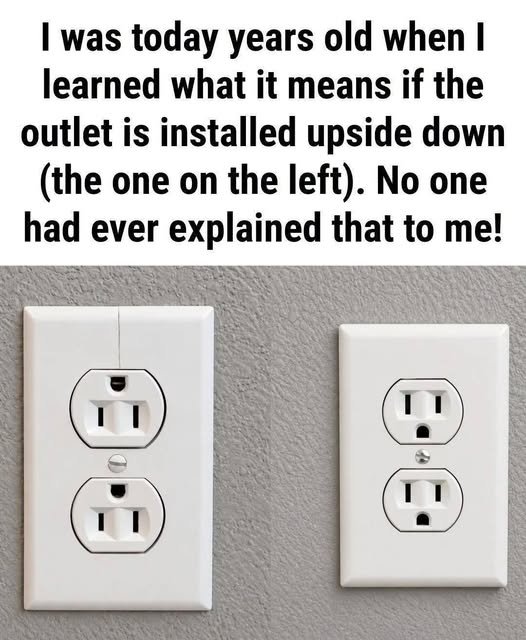
Have you ever walked into a home, office, or hotel room and noticed that one electrical outlet seemed to be installed upside down? Instead of the familiar arrangement—with the two vertical slots above and the round grounding hole below—you see the ground hole at the top.
At first glance, it may look like a mistake made by the electrician. Many people assume someone simply installed the outlet incorrectly. But in reality, there are several practical reasons why an outlet may be intentionally installed this way.
In fact, in certain settings, an upside-down outlet can actually improve safety, help identify special circuits, or follow local building practices.
Let’s explore why this unusual installation exists and whether it really makes a difference.
Is an Upside-Down Outlet Actually Installed Incorrectly?
The short answer is no.
In most countries, standard electrical outlets can legally and safely be installed in either orientation, provided they meet local electrical codes.
There is no universal rule that says the grounding hole must always face downward. The orientation often depends on:
- Local electrical codes
- Builder preferences
- Commercial installation standards
- Special circuit identification
- Safety considerations
This is why you may see different orientations even within the same building.
Understanding the Parts of an Electrical Outlet
Before discussing the reasons, it helps to know the basic parts of a common three-prong outlet.
A standard outlet includes:
- Two vertical slots
- One “hot” slot
- One “neutral” slot
- One round or U-shaped grounding hole
The grounding connection provides an additional layer of electrical safety by helping direct fault current safely to the ground.
The location of this grounding hole is what changes when an outlet is installed upside down.
Reason 1: Improved Safety if a Metal Object Falls
One of the most widely discussed reasons involves safety.
Imagine a plug that is partially pulled out of the wall.
Small portions of the metal prongs may become exposed.
Now imagine that a metal object such as:
- A paper clip
- A key
- A butter knife
- A picture frame
falls between the wall and the partially unplugged cord.
If the grounding hole is on top, the object is more likely to touch the ground pin first, which normally does not carry electricity during regular operation.
If the grounding hole is on the bottom, a falling metal object could potentially contact one of the energized prongs before the ground connection.
Although this situation is relatively uncommon, some electricians and institutions consider the upside-down orientation a small additional safety measure.
Reason 2: Hospitals Often Install Them This Way
If you’ve ever visited a hospital, you’ve probably seen outlets installed with the ground hole facing upward.
Hospitals often follow their own engineering standards designed to reduce electrical hazards.
The upside-down orientation helps maintenance workers quickly recognize specific medical-grade outlets.
Medical facilities also use outlets with distinctive colors or markings that meet strict healthcare electrical standards.
Reason 3: Identifying Switched Outlets
In many homes, one half of a wall outlet is controlled by a wall switch.
These switched outlets are commonly used for:
- Floor lamps
- Table lamps
- Holiday lighting
Some electricians intentionally install these outlets upside down so homeowners can immediately recognize that the outlet functions differently.
Although this is not required by electrical code, it has become a useful convention in some areas.
Reason 4: Builder or Electrician Preference
Sometimes there is no special reason at all.
Electricians may simply have personal preferences based on:
- Training
- Company standards
- Local customs
- Years of experience
One contractor may always install outlets with the ground pin down.
Another may always prefer the ground pin up.
Both methods can be acceptable when installed correctly.
Reason 5: Commercial Buildings Often Follow Different Standards
Many commercial buildings—including:
- Schools
- Offices
- Factories
- Government buildings
frequently use the ground-up orientation.
This can help create consistency throughout the building and may align with organizational maintenance practices.
Does Outlet Direction Affect Performance?
No.
Whether installed upright or upside down, the outlet delivers electricity the same way.
It does not affect:
- Voltage
- Charging speed
- Appliance performance
- Energy efficiency
The orientation simply changes the physical position of the grounding hole.
Is One Direction Safer?
Electrical experts continue to discuss this topic.
Some believe the ground-up position provides a slight advantage if a conductive object falls onto a partially unplugged cord.
Others point out that:
- Properly inserted plugs leave no exposed metal.
- Modern electrical systems include grounding and circuit protection.
- The overall difference in everyday safety is relatively small.
The most important safety factors are:
- Proper installation
- Correct wiring
- Undamaged outlets
- Safe electrical practices
Common Myths About Upside-Down Outlets
Myth 1: They’re Installed Incorrectly
False.
An upside-down outlet is not automatically a mistake.
Myth 2: They Mean the Wiring Is Dangerous
False.
Orientation alone says nothing about wiring quality.
Only proper testing can determine whether wiring is safe.
Myth 3: They Deliver More Electricity
False.
The orientation has no effect on electrical output.
Myth 4: Every Building Should Use the Same Direction
False.
Building practices vary depending on local codes, designers, and electricians.
When Should You Replace an Outlet?
Regardless of orientation, outlets should be replaced if they show signs such as:
- Cracks
- Burn marks
- Loose plugs
- Sparks
- Buzzing sounds
- Discoloration
- Excessive heat
These symptoms may indicate a potentially unsafe electrical issue that should be inspected by a qualified electrician.
Electrical Safety Tips for Every Home
Whether your outlets face up or down:
Never overload outlets.
Too many high-power devices can overheat wiring.
Replace damaged cords.
Frayed or broken cords should never be used.
Use outlet covers around children.
Safety covers help reduce the risk of accidental electrical shock.
Keep outlets dry.
Water and electricity are a dangerous combination.
Have older wiring inspected.
Homes with aging electrical systems may benefit from a professional inspection.
Why This Detail Surprises So Many People
Most of us use electrical outlets every day without giving them a second thought.
When we notice one installed differently, we naturally assume something is wrong.
In reality, that small design choice often reflects thoughtful planning, safety considerations, or simply a builder’s preferred method.
It’s one of those everyday details that many people overlook—until someone finally explains it.
Final Thoughts
An upside-down electrical outlet is usually not an installation mistake. In many cases, it’s an intentional choice made for safety, maintenance, or identification purposes. Some hospitals and commercial buildings prefer the ground-up orientation, and some electricians use it to mark switched outlets or follow company standards.
While the orientation itself has little effect on how the outlet works, understanding the reasons behind it can help you appreciate the practical thinking that sometimes goes into even the smallest features of a building.
The next time you spot an outlet installed “upside down,” you’ll know it might actually be exactly where it’s supposed to be.
Frequently Asked Questions
Is an upside-down outlet dangerous?
No. If it is properly wired and installed according to local electrical codes, it is generally just as safe as a traditionally oriented outlet.
Why do hospitals use upside-down outlets?
Some healthcare facilities use the ground-up orientation as part of their electrical standards and to help identify certain types of outlets.
Does outlet orientation affect charging speed?
No. The position of the outlet has no impact on the amount of electricity delivered to your devices.
Should I rotate my home’s outlets upside down?
There is usually no need unless a qualified electrician recommends it or you are following a specific design or code requirement.
What matters most for electrical safety?
Proper installation, correct wiring, undamaged outlets, avoiding overloaded circuits, and using electrical devices safely are far more important than whether the outlet is oriented up or down.