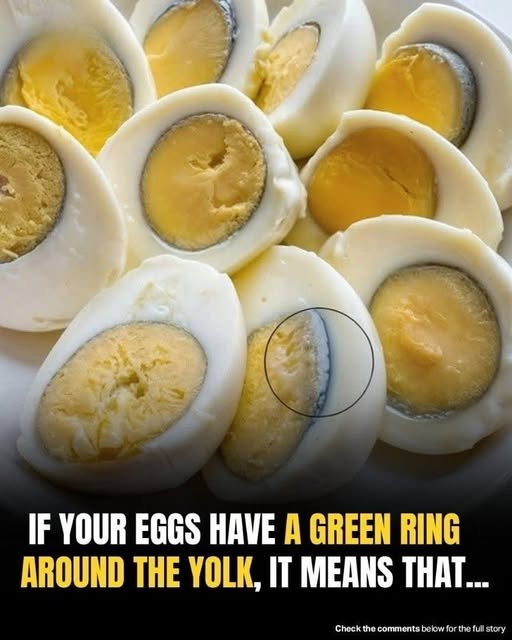
A green or gray ring around the yolk of a hard-boiled egg is a common cooking issue. It happens because of a natural chemical reaction inside the egg when it is exposed to heat for too long.
It is often called the “green yolk ring” or “gray yolk ring.”
What Causes the Green Ring?
An egg contains several minerals and proteins:
1. Sulfur in the Egg White
Egg whites contain sulfur-containing amino acids. When heated, these compounds break down and release small amounts of hydrogen sulfide gas (H₂S).
Hydrogen sulfide is the compound responsible for the familiar “rotten egg” smell.
2. Iron in the Egg Yolk
Egg yolks naturally contain iron.
When the egg is overcooked:
- Hydrogen sulfide from the white moves toward the yolk.
- Iron from the yolk reacts with the sulfur compounds.
- This forms iron sulfide (FeS).
Iron sulfide has a greenish-gray color, creating the ring around the yolk.
Does the Green Ring Mean the Egg Is Bad?
No. A green ring does not mean the egg is rotten.
A properly stored egg with a green ring is generally:
✅ Safe to eat
✅ Nutritious
✅ Not spoiled
The main differences are:
- The yolk may look less attractive.
- The texture may become slightly drier or more crumbly.
- The flavor may be slightly stronger if severely overcooked.
Why Do Some Eggs Get a Green Ring and Others Do Not?
Several factors affect it:
1. Cooking Time
The longer an egg cooks, the more likely the reaction will occur.
Example:
- 8–10 minutes → usually bright yellow yolk
- 12–15+ minutes → higher chance of green ring
2. Cooking Temperature
Very high heat speeds up chemical reactions.
Boiling eggs aggressively for a long time increases the chance of discoloration.
3. Cooling Speed
If eggs remain hot after cooking, the reaction continues.
A quick ice bath helps stop the process.
4. Egg Size
Larger eggs take longer to heat through, increasing the chance of overcooking if the cooking time is not adjusted.
The Best Way to Boil Eggs Without a Green Ring
Method: Gentle Boil + Ice Bath
Step 1: Prepare the eggs
- Use eggs from the refrigerator or room temperature.
- Place them in a single layer in a saucepan.
Step 2: Add water
- Cover eggs with about 2–3 cm (1 inch) of water.
Step 3: Heat gently
- Bring water to a boil over medium-high heat.
- Once boiling, reduce heat slightly.
Step 4: Cook
Recommended times:
| Egg Type | Cooking Time |
|---|---|
| Soft-boiled | 4–6 minutes |
| Medium-boiled | 7–9 minutes |
| Hard-boiled | 10–12 minutes |
Step 5: Cool immediately
- Transfer eggs into ice water.
- Leave for 5–10 minutes.
This stops cooking and prevents the sulfur reaction.
How to Tell If a Hard-Boiled Egg Is Actually Spoiled
A green ring is not a spoilage sign. Look for these instead:
Bad signs:
❌ Rotten or unusually strong smell
❌ Slimy egg white
❌ Mold or fuzzy growth
❌ Strange pink, black, or unusual patches
❌ Egg was stored improperly for too long
Normal signs:
✅ Green-gray ring around yolk
✅ Slightly darker yolk surface
✅ Firm egg white
Can You Still Eat an Overcooked Egg?
Yes. An overcooked egg can still be used in:
- Egg salad
- Sandwiches
- Deviled eggs
- Chopped egg toppings
- Cooking recipes
For better texture:
- Chop it finely.
- Mix with mayonnaise or yogurt.
- Add herbs and seasoning.
Extra Tips for Perfect Hard-Boiled Eggs
Use older eggs for easier peeling
Eggs that are about 1–2 weeks old often peel more easily than very fresh eggs.
Avoid boiling too aggressively
A gentle simmer cooks the egg more evenly.
Do not leave boiled eggs sitting in hot water
Remove them once cooked.
Store properly
Hard-boiled eggs:
- Keep refrigerated.
- Best used within about 1 week.
In short: The green ring around an egg yolk is a harmless chemical reaction caused by overcooking. The solution is simple: cook for the right amount of time and cool the eggs quickly after boiling.