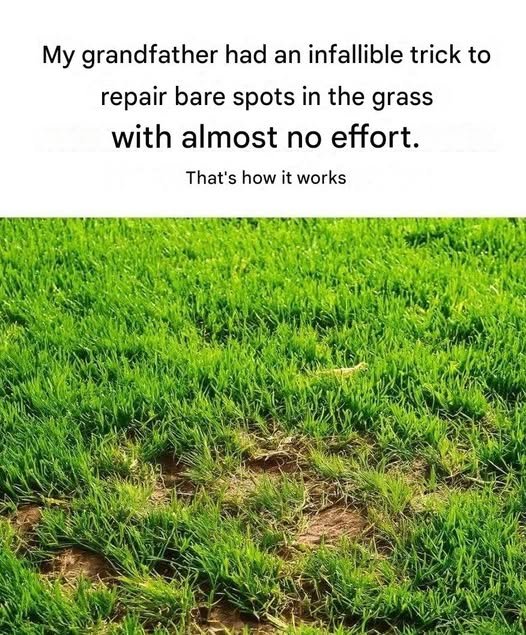
If you’ve spent any time on Facebook or other social media platforms, you’ve probably seen an image like this:
“My grandfather had an infallible trick to repair bare spots in the grass with almost no effort. That’s how it works.”
The post promises an incredible lawn-care secret that supposedly transforms patchy grass with little or no work.
So, what’s the secret?
The answer is simple: there usually isn’t one.
These posts are designed as clickbait—their goal is to make you curious enough to click a link, generating advertising revenue or directing you to a website filled with affiliate products.
Instead of revealing a magical solution, let’s look at what actually works.
Why Do Bare Spots Appear?
Before repairing your lawn, it’s important to understand why the grass disappeared in the first place.
Common causes include:
Heavy Foot Traffic
Children playing, pets running, or frequent walking can wear away grass until only bare soil remains.
Pet Urine
Dog urine contains high concentrations of nitrogen and salts.
Small amounts may green the grass, but repeated urination in the same area often burns the lawn, leaving brown or dead patches.
Soil Compaction
Hard, compacted soil prevents:
- Water from soaking in
- Oxygen from reaching roots
- Grass roots from expanding
Without healthy roots, grass struggles to survive.
Poor Watering
Both underwatering and overwatering can damage grass.
Lawns generally perform best with deep, infrequent watering rather than light daily sprinkling.
Lawn Diseases
Fungal diseases may create circular brown patches that continue spreading if left untreated.
Insect Damage
Grubs and other lawn pests feed on grass roots, causing the turf to die and pull away easily.
The “Grandfather’s Trick” That Actually Works
While there’s no magical shortcut, experienced gardeners have long relied on a simple process that consistently produces good results.
Step 1: Remove Dead Grass
Use a garden rake to remove:
- Dead grass
- Weeds
- Loose debris
This exposes the soil and improves seed-to-soil contact.
Step 2: Loosen the Soil
Break up the top 1–2 inches (2.5–5 cm) of soil.
Loose soil allows:
- Better root growth
- Improved drainage
- Easier seed germination
Step 3: Add Compost
Spread a thin layer of compost over the patch.
Compost improves:
- Soil fertility
- Moisture retention
- Beneficial microbial activity
Step 4: Apply Grass Seed
Choose grass seed that matches your existing lawn.
Popular varieties include:
- Kentucky Bluegrass
- Perennial Ryegrass
- Tall Fescue
- Fine Fescue
Using the wrong seed can make repaired areas stand out.
Step 5: Lightly Cover the Seed
Cover the seed with a thin layer of:
- Compost
- Topsoil
- Peat-free lawn dressing
This helps retain moisture while protecting the seed from birds.
Step 6: Water Carefully
Keep the soil consistently moist—not soggy.
During germination:
- Water lightly once or twice daily.
- Avoid allowing the soil to dry out.
Once the grass establishes:
- Water less frequently.
- Water more deeply to encourage strong roots.
Does Sugar Really Repair Bare Spots?
Some viral posts recommend sprinkling sugar over damaged grass.
There is no strong scientific evidence that sugar repairs lawns.
In fact, adding large amounts of sugar may interfere with soil nutrient balance rather than improve it.
What About Epsom Salt?
Another common internet “hack” involves Epsom salt.
Although magnesium is an essential plant nutrient, most lawns do not need extra magnesium unless a soil test confirms a deficiency.
Applying Epsom salt to a healthy lawn generally provides little benefit.
Can Dish Soap Make Grass Grow?
No.
Dish soap is sometimes used by lawn professionals as part of certain pest-control or soil-wetting applications, but it does not stimulate grass growth or repair bare patches.
Using household dish soap repeatedly may even damage grass.
Coffee Grounds: Helpful or Hype?
Coffee grounds contain organic matter and small amounts of nutrients.
Used sparingly in compost, they can contribute to soil health.
However, simply dumping coffee grounds on bare spots is unlikely to repair a lawn.
Fertilizer: Use It Wisely
Young grass benefits from nutrients, but more isn’t always better.
A starter fertilizer can support root development, while excessive fertilizer may burn new seedlings.
Always follow the product instructions.
Preventing Future Bare Spots
Repairing the lawn is only half the battle. Preventing new patches is just as important.
Reduce Heavy Traffic
Place stepping stones in frequently used areas.
Aerate Compacted Soil
Aerating once a year helps:
- Improve drainage
- Increase oxygen flow
- Encourage healthier roots
Water Properly
Aim for about 1 inch (2.5 cm) of water per week from rainfall and irrigation combined, adjusting for your climate and grass type.
Mow Correctly
Avoid cutting grass too short.
Keeping grass slightly taller helps:
- Shade the soil
- Reduce evaporation
- Encourage deeper roots
Feed the Lawn
Regular fertilization during the growing season helps maintain dense, healthy turf that naturally resists weeds and bare patches.
Why These Posts Go Viral
Posts like the one in the image succeed because they use curiosity gaps.
Instead of giving you the answer, they promise a secret that you’ll supposedly discover after clicking.
Common phrases include:
- “Gardeners don’t want you to know this…”
- “My grandfather’s secret…”
- “You’ll never believe what happened…”
- “This one simple trick…”
The goal is to encourage clicks—not necessarily to provide useful information.
The Bottom Line
Despite what viral posts suggest, there is no magical lawn-repair trick that instantly restores bare patches with almost no effort.
The most reliable approach remains the same:
- Identify the cause of the damage.
- Remove dead grass.
- Loosen the soil.
- Add compost if needed.
- Reseed or lay fresh sod.
- Keep the area consistently moist until the grass is established.
It may not be as exciting as a “secret grandfather’s trick,” but it’s the method that consistently delivers healthy, long-lasting results. With a little patience and proper care, even badly worn patches can grow back into a lush, green lawn.