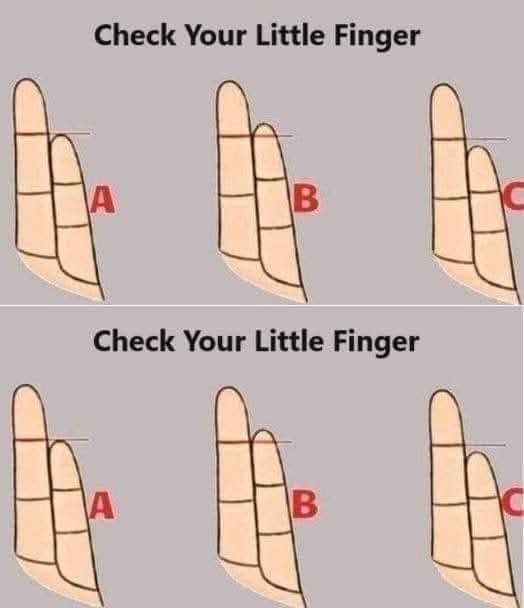
While these quizzes are entertaining, it’s important to know that they are not supported by scientific evidence. Your little finger cannot accurately determine your personality. However, exploring these interpretations can be a fun conversation starter, much like reading a horoscope.
Here’s a look at the most common personality descriptions associated with different little finger types.
Type A: The Reserved Thinker
If your little finger appears shorter and doesn’t reach the top joint of your ring finger, some personality quizzes suggest you may be:
- Thoughtful and observant
- Loyal to close friends and family
- Slow to trust new people
- Calm under pressure
- Independent and self-reliant
People with this finger type are often described as private individuals who prefer meaningful relationships over large social circles. They may take time to open up but are said to be dependable once they do.
Type B: The Balanced Communicator
If your little finger reaches approximately the top joint of your ring finger, online personality guides often describe you as:
- Honest and dependable
- Friendly and approachable
- Emotionally balanced
- Good at resolving conflicts
- Adaptable to different situations
According to these interpretations, people with this finger type tend to enjoy teamwork and are comfortable expressing themselves without dominating conversations.
Type C: The Confident Leader
If your little finger extends above the top joint of your ring finger, personality quizzes commonly associate it with:
- Confidence
- Strong communication skills
- Ambition
- Creativity
- Natural leadership
These individuals are often portrayed as outgoing, persuasive, and willing to take initiative in both personal and professional settings.
Why Do These Quizzes Feel So Accurate?
Many personality quizzes use broad, positive statements that could apply to a wide range of people. Psychologists sometimes refer to this as the Barnum effect (or Forer effect), where people tend to see vague, general descriptions as uniquely personal.
For example, statements like:
- “You care deeply about people close to you.”
- “You sometimes doubt yourself but are capable of great things.”
- “You enjoy recognition but also value your privacy.”
These descriptions resonate with many people regardless of their finger shape.
Does Finger Length Tell Us Anything Scientific?
Researchers have studied certain finger proportions—particularly the ratio between the index and ring fingers (known as the 2D:4D ratio)—to explore possible links with prenatal hormone exposure. However, findings are mixed, and these measurements cannot reliably predict personality, intelligence, or future success.
There is no scientific evidence that the length of the little finger alone reveals someone’s character or behavior.
What Really Shapes Personality?
Psychologists generally agree that personality develops through a combination of factors, including:
- Genetics
- Childhood experiences
- Family environment
- Education
- Culture
- Life experiences
- Personal choices
Rather than being determined by physical features, personality evolves throughout life as people learn, grow, and adapt.
Why These Personality Tests Remain Popular
Despite lacking scientific support, personality quizzes continue to attract millions of readers because they are:
- Fun and entertaining
- Easy to share with friends
- A way to spark conversations
- An opportunity for self-reflection
As long as they’re viewed as lighthearted entertainment rather than factual assessments, there’s no harm in enjoying them.
The Bottom Line
The idea that your little finger reveals beautiful things about your personality is an entertaining myth rather than a scientific fact. While online quizzes may describe traits like confidence, loyalty, or creativity based on finger length, there is no reliable evidence that the size or shape of your pinky can determine who you are.
Your personality is far more complex—shaped by your experiences, relationships, values, and choices over time. So, feel free to enjoy these hand-reading trends for fun, but remember that the most accurate picture of your personality comes from how you live, think, and treat others—not from the length of your little finger.