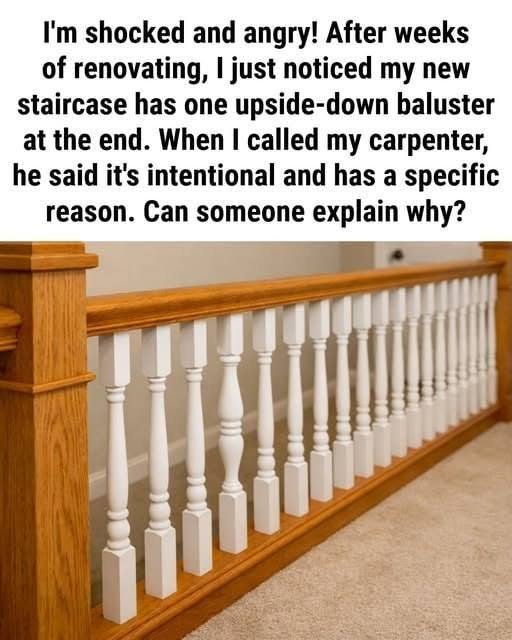
The image describes a staircase with one upside-down baluster (spindle) and asks why a carpenter would intentionally install it that way. While this story circulates widely online, there’s no universal building rule or carpentry requirement that says a staircase must have one inverted baluster. Instead, several traditions and explanations have been passed down over the years.
Is It Really Intentional?
Sometimes, yes. Skilled woodworkers have occasionally installed one upside-down baluster on purpose, but it’s usually a matter of tradition or personal preference, not structural necessity.
Common Explanations
1. A Symbol That Only Perfection Belongs to God
One of the oldest explanations comes from traditional craftsmanship.
Some carpenters believed that creating something perfectly was an act reserved for God. To acknowledge that human work is never truly perfect, they would intentionally include one small “imperfection,” such as:
- An upside-down baluster
- A slightly different carving
- A hidden irregularity
This served as a humble reminder that people are imperfect.
2. A Craftsman’s Signature
Before branding and logos became common, some artisans left subtle “signatures” in their work.
An inverted spindle could act as a discreet mark showing who built the staircase without carving their name into the wood.
3. A Family Tradition
Many woodworking techniques are passed from one generation to the next.
Some carpenters continue the practice simply because they learned it from a parent, grandparent, or mentor, even if the original meaning has been forgotten.
4. A Conversation Piece
Some builders intentionally add a unique feature so homeowners or guests eventually notice it.
It becomes a fun detail that gives the staircase a bit of personality.
Does It Have a Structural Purpose?
Generally, no.
Turning one turned wooden baluster upside down does not:
- Make the staircase stronger
- Improve safety
- Balance the railing
- Meet a building code requirement
If the baluster is properly attached, its orientation usually has little effect on its ability to support the handrail.
Could It Simply Be a Mistake?
Absolutely.
Not every upside-down baluster is intentional. During installation, especially when many identical spindles are involved, one may accidentally be installed the wrong way. If the homeowner notices it, the carpenter may replace it—or, in some cases, jokingly refer to it as a “tradition.”
Building Codes Focus on Safety
Modern building codes are concerned with factors such as:
- Proper spacing between balusters
- Secure attachment to the railing and base
- Appropriate railing height
- Overall structural stability
The direction of a decorative turned baluster is typically not addressed by code, provided the installation remains safe.
Final Thoughts
The claim that every staircase must have one upside-down baluster for a specific reason is more folklore than fact. While some woodworkers intentionally include one as a symbol of humility, a personal signature, or a family tradition, there is no universal carpentry rule requiring it. In many cases, it’s simply a decorative choice—or even an honest installation mistake.
So if you spot an upside-down baluster on a staircase, it may have a story behind it—but it doesn’t necessarily mean anything is wrong with the craftsmanship.