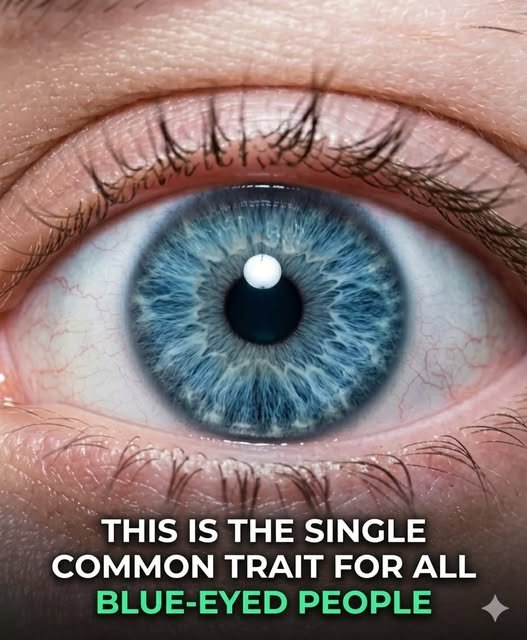
Headlines like “All blue-eyed people have this in common” are usually trying to turn a real genetic fact into something dramatic. The truth is interesting—but not mysterious.
The real shared factor: reduced iris melanin
Eye color is determined mainly by how much pigment (melanin) is stored in the iris. Blue eyes are not caused by a blue pigment. Instead, they result from very low melanin levels in the front layer of the iris.
When light enters the eye:
- Dark brown eyes absorb most light because they have a lot of melanin.
- Blue eyes have less melanin, so light scatters in the iris tissue.
- This scattering (called Rayleigh scattering) makes the eye appear blue.
So the “common thing” among blue-eyed people is:
A genetic setup that leads to reduced melanin production in the iris.
The main gene involved
The strongest known genetic influence comes from:
OCA2
- OCA2 controls how much melanin cells can produce.
- However, most blue-eyed people don’t have a broken OCA2 gene.
- Instead, OCA2 is turned down (reduced expression) rather than disabled.
The real switch: HERC2
A nearby regulatory region in the gene:
- HERC2
acts like a “dimmer switch” for OCA2.
What happens in blue eyes:
- A specific variant in HERC2 reduces OCA2 activity.
- Less melanin is produced in the iris.
- Eyes appear blue instead of brown.
Important correction: not all blue eyes come from one ancestor
A popular claim online says:
“All blue-eyed people come from a single ancestor who had a mutation.”
This is partly simplified and often misrepresented.
What science actually suggests:
- The main HERC2 variant likely originated from one ancient mutation event thousands of years ago.
- However:
- It spread widely through populations via inheritance.
- Eye color is influenced by multiple genes.
- Slight variations can produce different shades (blue, gray, greenish-blue).
So:
- There may have been a single origin of a key mutation
- But blue-eyed people today are not all closely related in a recent sense
Why blue eyes are common in some populations
Blue eyes are most frequent in regions where this variant became common:
- Northern Europe
- Baltic region
- Parts of Eastern Europe
Why it persisted:
- Genetic drift (random inheritance patterns)
- Population bottlenecks (small groups expanding)
- Possible sexual selection (debated, not proven strongly)
What blue-eyed people DO NOT share (common myths)
There is no scientific basis for claims like:
- ❌ Better night vision or eyesight
- ❌ Higher intelligence or specific personality traits
- ❌ Greater sensitivity to pain or emotions
- ❌ Health advantages or disadvantages from eye color alone
Eye color is mostly cosmetic, not functional.
Why eye color varies at all
Eye color is a polygenic trait, meaning multiple genes contribute:
Besides OCA2 and HERC2, genes like:
- SLC24A4
- TYR
- IRF4
also influence:
- shade intensity
- green/hazel mixing
- variation between siblings
That’s why:
- Two brown-eyed parents can sometimes have a blue-eyed child
- Eye color can shift slightly in childhood
Why blue eyes can look different in different people
Even among blue-eyed individuals:
- Some have pale icy blue eyes (very low melanin)
- Others have gray-blue or greenish tones (slightly more pigment or different light scattering)
- Lighting, clothing, and pupil size can change perception
Bottom line
The only real thing all blue-eyed people share is:
A genetic variation that reduces melanin production in the iris, mainly involving regulation of the **OCA2 gene via HERC2.
Everything beyond that—personality traits, abilities, or health claims—is myth or exaggeration.
If you want, I can break down:
- how two brown-eyed parents can still have a blue-eyed child (with Punnett-style explanation),
- or how hazel and green eyes form genetically (it’s more complex than people think).