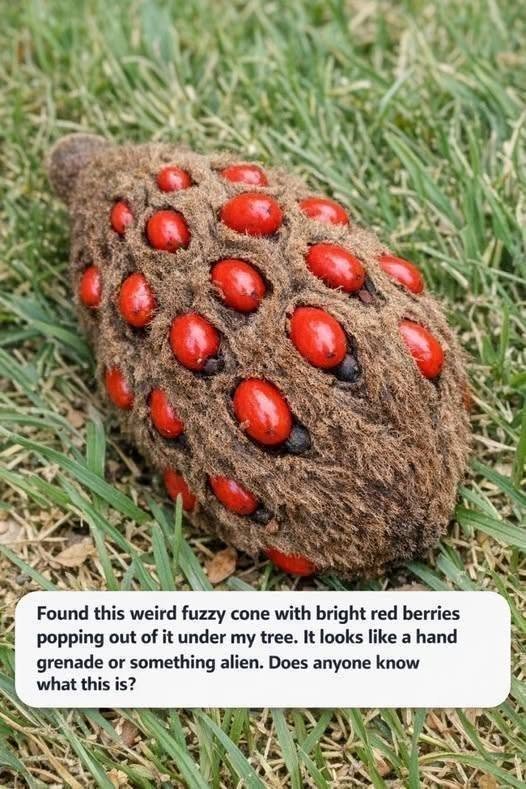
It’s not from another planet—though it absolutely earns the comparison. What you’re probably looking at is a magnolia seed cone, one of the more dramatic seed structures you’ll find in a garden or park.
The “grenade” under your tree: what you’re actually seeing
At first glance, it’s easy to understand the confusion. A fuzzy, cone-shaped structure sitting under a tree, split open and revealing clusters of bright red, almost jewel-like seeds spilling out. It can look artificial—like something designed for a movie set rather than grown in soil.
But this is a natural stage in the life cycle of a magnolia tree.
When the tree finishes flowering, it produces a cone-like seed pod. As it matures, it gradually opens up to reveal seeds that are coated in a bright red, fleshy covering.
Why it looks so unusual
Magnolias didn’t evolve to look subtle.
The seed structure has three features that make it stand out:
- Cone-shaped woody pod that resembles a pinecone or strange fossil
- Bright red seeds that contrast sharply against the brown outer shell
- A slightly sticky or fleshy texture when fresh
When the pod splits open, the red seeds often hang or cluster together, giving it an almost “organic explosion” effect—which is where that hand-grenade comparison comes from.
What’s going on biologically
The bright red color isn’t random decoration—it’s a strategy.
Magnolias rely on animals, especially birds, to spread their seeds. The process works like this:
- The seed pod opens when it’s mature
- Red-coated seeds become exposed
- Birds are attracted to the bright color
- They eat the fleshy coating and carry seeds away
- The tree gets natural seed dispersal without wind or machinery
So what looks like something surreal is actually a highly efficient survival strategy.
Is it dangerous or edible?
Despite the dramatic appearance, magnolia seeds are not dangerous in the way people often assume, but they’re also not typically considered edible for humans in any casual sense.
- The red coating is mostly attractive to birds
- The inner seed is hard and not commonly eaten
- No explosive or toxic “grenade” properties exist—just botanical theater
So while it looks alarming, it’s harmless in a physical sense.
Why you’re noticing it now
Magnolia seed cones are most visible in late summer through autumn, depending on the species and climate. They often fall to the ground beneath the tree once they open, which is likely why you found it under your tree rather than still attached.
Once they hit the ground, they can look even stranger—half-open, messy, and scattered with red seeds.
The takeaway
What looked like something alien or explosive is actually one of nature’s more visually dramatic seed dispersal systems. The magnolia doesn’t just produce flowers—it produces a second act that’s just as striking, even if most people never notice it.
Next time you see one, it’s less “hand grenade” and more “botanical packaging revealing its contents.”