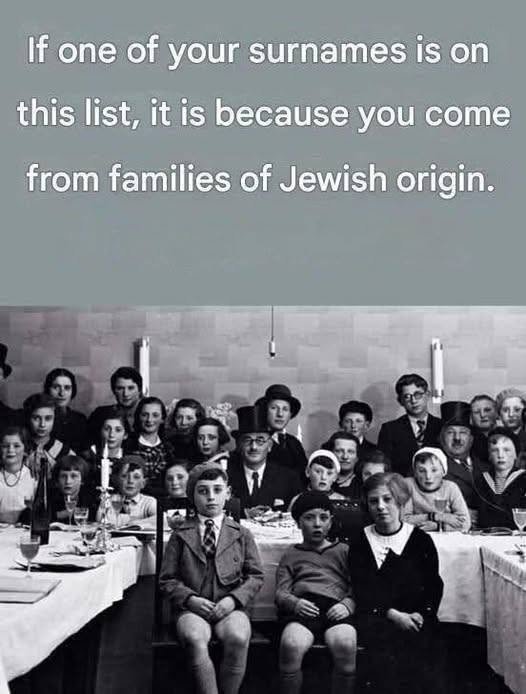
A last name can offer fascinating clues about a family’s history, but it is not proof of ethnicity or religion. Many surnames commonly associated with Jewish families have also been adopted by people of different backgrounds over the centuries through migration, conversion, marriage, or changes in spelling.
If you’ve ever wondered whether your surname might have Jewish roots, here’s what you should know.
How Jewish Surnames Developed
For much of history, many Jewish communities used patronymics (such as “son of”) rather than fixed family names. In the late 18th and 19th centuries, governments across Europe required families to adopt permanent surnames for tax and legal purposes. As a result, Jewish surnames came from several sources:
- Occupations
- Biblical or Hebrew personal names
- Geographic locations
- Nature-inspired words
- German, Yiddish, Slavic, or Spanish influences
Because of this, Jewish surnames are incredibly diverse.
Common Surnames Often Associated with Jewish Heritage
While none of these names guarantee Jewish ancestry, they are frequently found in Jewish communities:
- Cohen, Cohn, Kohn, Katz
- Levy, Levi, Levin, Levine
- Rosenberg
- Goldberg
- Greenberg
- Silverman
- Friedman
- Bernstein
- Rubin
- Shapiro
- Epstein
- Weiss
- Schwartz
- Stein
- Adler
- Horowitz
- Perlman
- Kaplan
- Mendelson
- Abramson
- Jacobson
- Hirsch
- Bloom
- Eisenberg
Many of these surnames have German or Yiddish origins and became widespread among Ashkenazi Jewish families.
What Do Cohen and Levy Mean?
Two of the best-known Jewish surnames have special historical significance:
- Cohen comes from the Hebrew word for “priest” and traditionally indicates descent from the ancient priestly class.
- Levy or Levi is associated with the biblical Tribe of Levi, whose members held religious responsibilities in ancient Israel.
Even so, modern DNA and genealogy research has shown that not everyone with these names shares the same ancestry.
Sephardic Jewish Surnames
Families with Sephardic Jewish heritage—whose ancestors lived in Spain and Portugal before the expulsions of the late 15th century—may have surnames such as:
- Toledano
- Cardozo
- Navarro
- Franco
- Pinto
- Abarbanel
- Espinoza
- Fonseca
These names also appear among many non-Jewish families throughout Spain, Portugal, and Latin America.
Why a Last Name Isn’t Enough
Surnames often crossed religious and cultural boundaries over generations. Immigration officials sometimes altered spellings, families voluntarily changed names to fit into new societies, and unrelated families ended up sharing identical surnames.
For that reason, a surname alone cannot confirm Jewish ancestry.
How to Learn More About Your Family History
If you’re curious about your roots, consider combining several research methods:
- Interview older relatives about family history.
- Search birth, marriage, and immigration records.
- Build a family tree using genealogy resources.
- Explore historical synagogue or community records where available.
- Consider a reputable DNA ancestry test, keeping in mind that genetic results estimate ancestral origins and cannot determine a person’s religion or cultural identity.
Final Thoughts
Having a surname commonly associated with Jewish communities can be an interesting starting point for exploring your family history—but it should never be treated as definitive evidence of Jewish ancestry. The most reliable picture comes from combining historical records, family stories, and, if you choose, genetic genealogy.
Your last name may hold a piece of your family’s story, but discovering your true heritage usually requires looking far beyond the name itself.