Picking a great watermelon is part observation, part experience. While no method is perfect, combining several signs greatly improves your chances of getting a sweet, ripe melon.
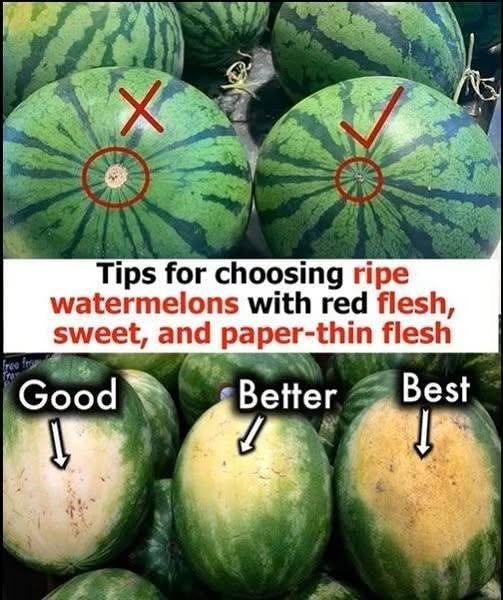
1. Look for the Field Spot (One of the Best Indicators)
The field spot is the area where the watermelon rested on the ground while growing.
- Creamy yellow to deep golden yellow = usually ripe and sweet.
- White or pale green = likely picked too early and may be less sweet.
A large yellow field spot generally indicates the melon spent enough time ripening on the vine.
2. Check the Weight
Pick up several watermelons of similar size.
- Choose the one that feels heavier than it looks.
- A heavy watermelon contains more water, which often indicates good ripeness and juiciness.
For example, if two melons are the same size, the heavier one is usually the better choice.
3. Look for a Dull, Not Shiny, Surface
- A matte or dull rind often signals maturity.
- A very shiny rind can indicate the fruit was harvested before reaching full ripeness.
The surface should also be firm and free of soft spots.
4. Tap and Listen
The classic “thump test” can be helpful.
Gently knock on the watermelon:
- Deep, hollow sound = typically ripe and full of water.
- Flat, dull sound = may be overripe.
- High-pitched sound = may be underripe.
This method works best when combined with the other signs.
5. Look for Uniform Shape
Choose a watermelon that is:
- Symmetrical
- Evenly rounded or evenly elongated
- Free of major dents, bumps, or irregular growth
Misshapen fruit can sometimes indicate uneven watering or growing conditions.
6. Examine the Webbing or Sugar Spots
Brown, rough, web-like markings on the rind are often called “webbing.”
- Moderate webbing can be a sign that bees pollinated the flower well.
- Many watermelon lovers associate these marks with sweeter fruit.
Small dark sugar spots where sugar has seeped out can also be a positive sign.
7. Avoid Damage
Pass on watermelons with:
- Soft spots
- Cracks
- Punctures
- Mold
- Deep bruises
Minor surface scratches are usually harmless.
8. Check the Stem (If Present)
If a stem remains attached:
- Dry, brown stem = generally indicates the melon ripened on the vine.
- Green stem = may suggest it was harvested early.
Many store-bought watermelons no longer have stems, so don’t rely on this sign alone.
9. Choosing Seeded vs. Seedless
There’s no universal winner:
- Seeded varieties are often considered slightly sweeter by some consumers.
- Seedless varieties are more convenient and can be just as sweet when ripe.
Ripeness indicators are the same for both.
Quick 30-Second Store Test
If you’re in a hurry:
- Find a creamy yellow field spot.
- Pick the heaviest melon for its size.
- Make sure the rind is dull, not shiny.
- Give it a tap and listen for a deep hollow sound.
When all four signs are present, your odds of getting a sweet watermelon are very good.
Common Myths
❌ Bigger watermelons are always sweeter.
Size alone doesn’t determine sweetness.
❌ Dark green means ripe.
Color varies by variety.
❌ A perfectly round watermelon is always sweeter than an oval one.
Shape mainly reflects the variety, not sweetness.
Best Time to Buy
In many regions, the sweetest watermelons are available during peak summer, when they are harvested closer to natural ripeness. Depending on location, this is often from late spring through early autumn.
Summary
The most reliable combination is:
✅ Creamy yellow field spot
✅ Heavy for its size
✅ Dull rind
✅ Deep hollow sound when tapped
✅ Firm, undamaged skin
Using all of these clues together gives you the best chance of bringing home a sweet, juicy watermelon. 🍉