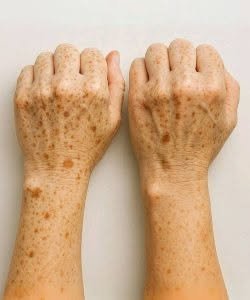
As we get older, many people begin noticing small brown spots appearing on their hands, face, shoulders, and other areas that receive regular sunlight.
They are often called age spots, sun spots, or liver spots — and despite the nickname, they have nothing to do with the liver.
So why do these spots appear?
The answer comes down to a combination of sun exposure, skin ageing, and changes in pigment production.
1. Years of Sun Exposure Build Up Over Time ☀️
The biggest factor behind many age spots is ultraviolet (UV) exposure.
Your skin produces a pigment called melanin, which helps protect cells from UV radiation. After years of repeated sun exposure, pigment-producing cells called melanocytes can become unevenly distributed or more active in certain areas.
The result can be:
- Flat brown patches
- Uneven skin tone
- Darkened areas on sun-exposed skin
These changes often appear later in life because the damage accumulates gradually.
2. Skin’s Repair System Changes With Age
Younger skin is constantly repairing and renewing itself.
As we age, several changes occur:
- Skin cell turnover slows
- Collagen production decreases
- Repair processes become less efficient
This means the effects of years of environmental exposure may become more visible.
Age spots are often a reminder of what the skin has experienced over decades.
3. Genetics Also Play a Role
Not everyone develops the same number of spots, even with similar sun exposure.
Your likelihood can be influenced by:
- Skin type
- Family history
- Natural pigmentation
- Lifestyle factors
Some people are more prone to visible pigmentation changes than others.
4. They Are Usually Harmless — But Changes Matter
Most age spots are harmless. However, it is important to pay attention to spots that:
- Change quickly
- Have uneven borders
- Develop multiple colours
- Bleed or become crusty
- Grow noticeably
A dermatologist or healthcare professional can check any spot that looks unusual.
5. Prevention Is Still Possible at Any Age
Even after years of sun exposure, protecting your skin can help prevent further damage.
Helpful habits include:
✅ Using broad-spectrum sunscreen
✅ Wearing hats and protective clothing outdoors
✅ Avoiding prolonged midday sun
✅ Having regular skin checks if you are at higher risk
Sun protection is not only about preventing wrinkles — it also helps protect against harmful skin changes.
Can These Spots Be Reduced?
Depending on the type of pigmentation and your skin, treatments a dermatologist may discuss include:
- Prescription creams
- Chemical peels
- Laser treatments
- Cryotherapy
- Other professional skin procedures
Results vary, and not every treatment is suitable for every person.
The Real Reason These Spots Appear
Those small brown marks are usually not a sign that your body is failing. They are often the visible result of decades of sunlight, natural ageing, and individual genetics.
Your skin keeps a record of your life — and these spots are one of the ways that history can appear on the surface.
If a spot is new, changing, or unusual, it is worth having it checked. Otherwise, many of these marks are simply a normal part of how skin changes over time. ✨