This Simple Math Problem Is Dividing the Internet: Can You Solve It?
Every few months, a seemingly simple math problem goes viral and sparks heated debates across social media. Thousands of people confidently post different answers, each claiming their solution is correct.
But why do these problems cause so much confusion?
The answer usually comes down to the order of operations—the set of rules mathematicians use to determine which calculations should be performed first.
A Viral Example
Consider this expression:
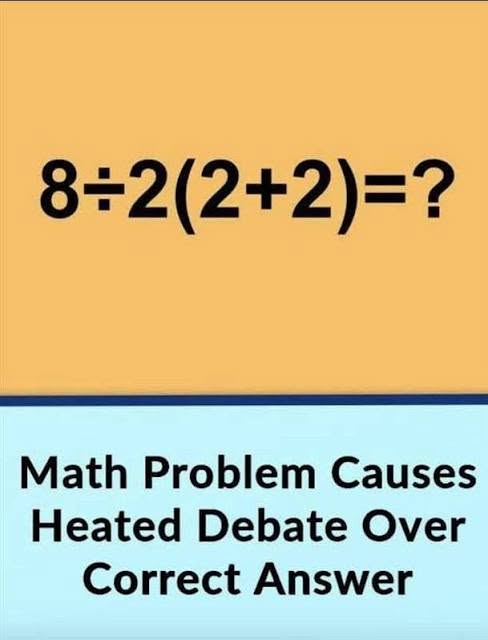
8 ÷ 2(2 + 2)
At first glance, it looks straightforward. Yet it has generated countless arguments online, with many people arriving at either 1 or 16.
Step 1: Solve the Parentheses
First, calculate:
(2 + 2) = 4
The expression becomes:
8 ÷ 2 × 4
Step 2: Apply the Order of Operations
According to standard mathematical conventions, multiplication and division have the same priority. When they appear together, you work from left to right.
So:
- 8 ÷ 2 = 4
- 4 × 4 = 16
Answer: 16
Why Do Some People Get 1?
Those who arrive at 1 often treat 2(4) as a single unit and effectively calculate:
8 ÷ 8 = 1
This interpretation comes from older notational styles or ambiguity in how the problem is written.
In modern mathematical practice, expressions like this are considered poorly written because they can be interpreted in more than one way.
The Real Lesson
The debate isn’t usually about arithmetic skills—it’s about notation.
Professional mathematicians generally avoid writing expressions that can be read in multiple ways. Instead, they add extra parentheses to make the intended meaning clear.
For example:
- 8 ÷ [2(2 + 2)] = 1
- (8 ÷ 2)(2 + 2) = 16
Both are valid calculations, but they represent different expressions.
Why These Problems Go Viral
These puzzles spread because they combine:
- Simple arithmetic
- Hidden ambiguity
- Strong opinions
- The satisfaction of proving someone wrong
As a result, comment sections quickly fill with competing explanations and passionate debates.
The Bottom Line
When a math problem “divides the internet,” the disagreement is often caused by ambiguous notation rather than difficult mathematics. The safest approach is to follow the standard order of operations and, when writing expressions yourself, use parentheses generously to eliminate confusion.
After all, in math, clarity is just as important as the answer itself.