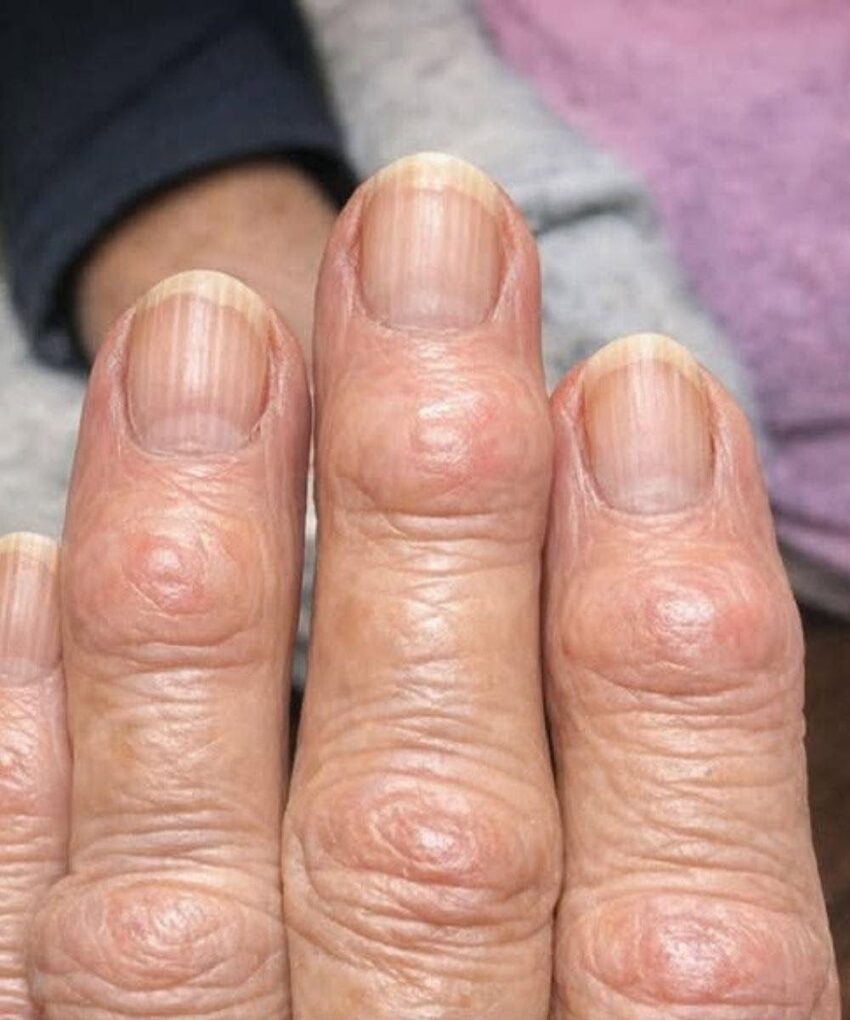
Have you ever noticed small, hard bumps developing on the joints closest to your grandmother’s fingernails? At first, they may seem like ordinary swelling, but over time they can become larger, firmer, and appear on several fingers. Many families wonder if these bumps are simply a normal part of aging or a sign of something more serious.
In many older adults, these bumps are a common feature of Osteoarthritis, the most common form of arthritis. Although they can change the appearance of the hands and sometimes cause discomfort, they are usually not dangerous. Understanding why they develop can help you recognize when simple self-care is enough and when it’s important to seek medical advice.
What Are These Hard Bumps?
The hard bumps that form on the finger joints closest to the fingernails are known as Heberden’s nodes. They develop at the distal interphalangeal (DIP) joints, which are the last joints before the fingertips.
Unlike soft swelling caused by an injury or infection, Heberden’s nodes are made of extra bone that forms around a joint as part of the changes seen in Osteoarthritis.
These bumps often:
- Feel hard and bony
- Develop slowly over months or years
- Affect more than one finger
- May occur on one or both hands
Why Are They Spreading to More Fingers?
Many people notice that the bumps don’t stay on just one finger. Over time, they seem to appear on several fingers, giving the impression that they’re spreading.
This happens because Osteoarthritis is a progressive joint disease. Instead of affecting only one joint, it often develops in multiple joints throughout the hands.
As the protective cartilage gradually wears away, the body tries to stabilize the damaged joint by producing extra bone around it. These bony growths become visible as Heberden’s nodes.
The process usually occurs gradually over several years rather than all at once.
What Causes Osteoarthritis?
Healthy joints are covered by smooth cartilage that allows bones to glide easily during movement.
In Osteoarthritis:
- Cartilage slowly breaks down.
- Bones begin rubbing against one another.
- The joint becomes irritated.
- New bone forms around the joint edges.
- The joint may become enlarged and less flexible.
This is why the bumps feel firm rather than soft.
Who Is Most Likely to Develop These Bumps?
Several factors increase the likelihood of developing Heberden’s nodes.
1. Aging
The risk rises with age because cartilage naturally becomes thinner over time.
2. Genetics
Heberden’s nodes often run in families. If parents or grandparents developed similar bumps, other family members may also be more likely to experience them.
3. Women After Menopause
Women are affected more often than men, particularly after menopause. Hormonal changes may play a role in the development of hand osteoarthritis.
4. Previous Hand Injuries
Past fractures, sprains, or joint injuries can increase the risk of osteoarthritis developing later.
5. Repetitive Hand Use
Years of activities involving frequent gripping, pinching, sewing, knitting, gardening, or manual labor may contribute to joint wear in some individuals.
What Symptoms Can Occur?
The bumps don’t always appear overnight.
Early symptoms may include:
- Mild joint pain
- Tenderness
- Slight swelling
- Warmth around the joint
- Difficulty bending the finger
As the disease progresses, the bumps often become:
- Hard
- Larger
- Permanent
- Less painful than during the early stages
Some people also experience:
- Morning stiffness lasting less than 30 minutes
- Reduced finger flexibility
- Weaker grip strength
- Difficulty opening jars or buttoning clothes
- Changes in finger shape or alignment
Are These Bumps Painful?
Pain varies from person to person.
Some people experience pain only while the bumps are developing. Once the bony enlargement is fully formed, discomfort often decreases.
Others may continue to have stiffness or aching, especially after heavy use of their hands or during cold weather.
Could It Be Something Other Than Osteoarthritis?
Although Heberden’s nodes are strongly associated with Osteoarthritis, not every bump near the fingernails has the same cause.
Other possibilities include:
Rheumatoid Arthritis
Rheumatoid arthritis is an autoimmune disease that usually affects different finger joints, often causing softer swelling, prolonged morning stiffness, and inflammation in multiple joints.
Gout
Gout can sometimes cause firm deposits called tophi around finger joints, although it more commonly affects the big toe.
Digital Mucous Cysts
These are small, fluid-filled cysts that often develop near the fingernail and may sometimes press on the nail, causing ridges.
Less Common Causes
Infections, injuries, or other inflammatory joint conditions may also produce swelling, though these usually have different symptoms.
How Do Doctors Diagnose These Bumps?
A healthcare professional can often diagnose Heberden’s nodes through:
- A physical examination
- Reviewing symptoms
- Looking at the pattern of affected joints
If the diagnosis is uncertain, additional tests may include:
- X-rays to evaluate joint damage
- Blood tests to help rule out inflammatory arthritis
- Occasionally, ultrasound imaging
Can These Bumps Be Removed?
Unfortunately, once Heberden’s nodes develop, the extra bone cannot usually be reversed.
Treatment focuses on relieving symptoms and maintaining hand function rather than removing the bumps.
Ways to Manage Symptoms
Many people find relief through a combination of self-care and medical treatment.
Helpful strategies include:
Gentle Hand Exercises
Stretching and strengthening exercises help maintain mobility and reduce stiffness.
Warm Compresses
Applying warmth for 10–15 minutes may ease stiffness before activities.
Joint Protection
Using larger-handled kitchen utensils, jar openers, and ergonomic tools can reduce stress on painful joints.
Rest During Flare-Ups
Avoid repetitive gripping or forceful hand movements when symptoms worsen.
Medications
A healthcare professional may recommend over-the-counter pain relievers or anti-inflammatory medications if appropriate.
Hand Therapy
An occupational or physical therapist can teach exercises and techniques to improve hand function and reduce discomfort.
When Should You Be Concerned?
Although these bumps are usually harmless, seek medical evaluation if:
- Pain becomes severe or persistent
- A joint becomes red, hot, or very swollen
- The bumps appear suddenly
- Fever accompanies joint symptoms
- Hand weakness or deformity rapidly worsens
- Daily activities become difficult because of pain or stiffness
These symptoms may suggest another condition that requires different treatment.
Can Osteoarthritis Be Prevented?
There is no guaranteed way to prevent Osteoarthritis, but healthy habits may help protect your joints:
- Maintain a healthy weight
- Stay physically active
- Perform regular hand-strengthening exercises
- Protect your hands from repetitive strain
- Treat hand injuries promptly
- Eat a balanced diet rich in fruits, vegetables, whole grains, and healthy fats
While these steps cannot eliminate the risk, they support overall joint health and mobility.
Final Thoughts
Hard bumps near the fingernails are most often Heberden’s nodes, a common feature of Osteoarthritis. They develop because the body’s joints gradually change over time, leading to cartilage loss and new bone formation. Although the bumps may spread to several fingers and permanently change the appearance of the hands, they are usually not dangerous.
With the right combination of self-care, gentle exercise, joint protection, and medical guidance when needed, many people continue to use their hands comfortably and maintain an active, independent lifestyle despite these changes.