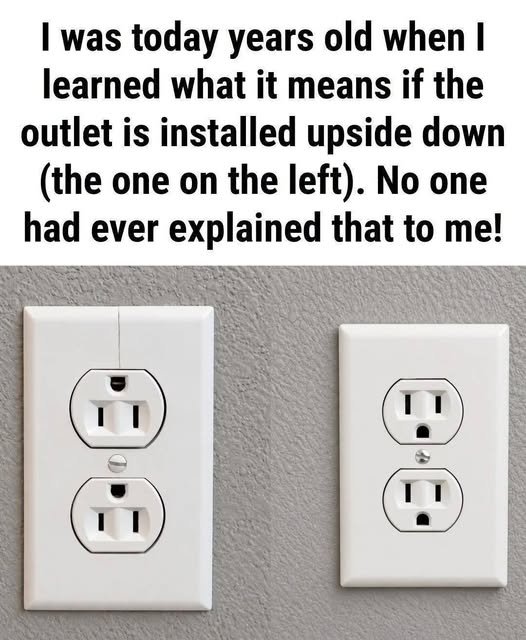
Surprisingly, that’s often not the case.
In fact, many electricians, engineers, hospitals, schools, and commercial buildings intentionally install certain outlets upside down for practical and safety-related reasons. Once you understand why, you’ll never look at electrical outlets the same way again.
Is There a “Right” Way to Install an Outlet?
One of the biggest misconceptions is that electrical outlets have a required “up” or “down” orientation.
In reality, standard North American receptacles are generally designed to function equally well in either direction. Unless a local code, manufacturer, or facility has a specific requirement, installing the grounding slot at the top or bottom is usually acceptable.
That’s why you might see different orientations even within the same building.
The Safety Reason Behind Upside-Down Outlets
The most common explanation involves an added layer of electrical safety.
Imagine a plug is partially pulled out of the outlet, leaving its metal prongs slightly exposed.
If a metal object—such as a picture frame, butter knife, or loose tool—falls between the wall and the partially unplugged cord, here’s what can happen:
- Ground pin on top: The object is more likely to contact the grounded pin first, reducing the chance of creating a dangerous short circuit.
- Ground pin on bottom: The object could bridge the exposed hot and neutral prongs before touching the ground, increasing the risk of sparks or electrical arcing.
Although this situation is uncommon, placing the grounding slot on top may offer a small safety advantage in certain environments.
A Simple Way to Identify Switched Outlets
In many homes, an upside-down outlet has nothing to do with safety.
Electricians sometimes rotate an outlet to indicate that one or both receptacles are controlled by a wall switch.
This visual cue helps homeowners identify which outlet is switched without removing the cover plate or testing the wiring.
However, this is a convention rather than a universal rule, so you shouldn’t assume every upside-down outlet is switch-controlled.
Why Hospitals Often Install Them This Way
Hospitals frequently use outlets with the grounding hole on top.
There are several reasons:
- Enhanced safety around sensitive medical equipment.
- Easier identification of hospital-grade receptacles.
- Consistent installation practices across healthcare facilities.
Hospital-grade outlets are also manufactured to stricter durability and performance standards than standard residential outlets.
Commercial Buildings Use Them Too
Many offices, schools, laboratories, and industrial facilities adopt the same orientation.
Reasons include:
- Consistent installation practices.
- Easier maintenance.
- Reduced risk of accidental short circuits.
- Quick identification of specific electrical circuits.
Does It Affect How the Outlet Works?
No.
Whether installed right-side up or upside down, a properly wired outlet provides the same electrical power and performs exactly as intended.
The orientation alone has no effect on:
- Voltage
- Electrical performance
- Appliance operation
- Energy efficiency
Proper wiring and installation are what matter most.
Should You Flip Your Outlets?
For most homeowners, there is no need to rotate existing outlets simply because they’re “upside down.”
If you’re remodeling or installing new receptacles, follow local electrical codes and consult a qualified electrician if you’re unsure about the preferred orientation.
Never remove or reinstall electrical outlets unless you know how to safely disconnect power and verify that the circuit is de-energized.
Other Reasons You Might See an Upside-Down Outlet
Occasionally, an outlet is inverted for reasons unrelated to safety, including:
- Matching nearby outlet orientations.
- Identifying dedicated appliance circuits.
- Accommodating the design of certain plugs or furniture layouts.
- Simply following the electrician’s standard practice.
The Bottom Line
An upside-down electrical outlet isn’t usually a mistake—it’s often intentional. In some cases, it’s installed to provide a small safety benefit by placing the grounding slot on top. In others, it serves as a visual indicator for switch-controlled or dedicated circuits, especially in commercial buildings and hospitals.
So the next time you spot an outlet that appears “backward,” don’t assume it was installed incorrectly. It may actually reflect a thoughtful design choice made with safety, convenience, or identification in mind.