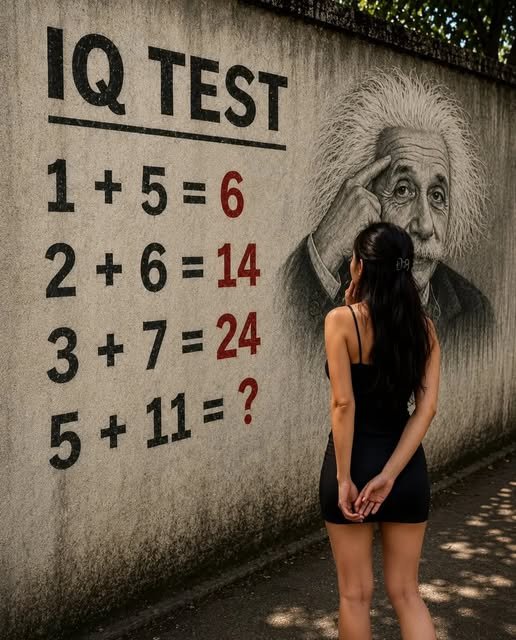
You’ve probably seen headlines like “Only people with a high IQ can solve this math puzzle” spreading across social media. These puzzles are designed to look intimidating, but they usually test something more specific than intelligence: attention to detail, logical thinking, and the ability to spot patterns.
A person’s ability to solve a puzzle does not determine their IQ. Many factors—such as experience, familiarity with puzzles, concentration, and problem-solving strategies—can affect performance.
That said, these puzzles can be a fun way to challenge your brain.
Try This Puzzle
Can you find the missing number?
2 + 3 = 10

4 + 5 = 36

6 + 7 = 78

8 + 9 = ?
Take a moment before looking at the answer.
The Solution
The trick is to look for the hidden pattern.
For the first equation:
2 + 3 = 10
A possible pattern is:
(2+3)×2=10(2 + 3) \times 2 = 10(2+3)×2=10
For the second:
(4+5)×4=36(4 + 5) \times 4 = 36(4+5)×4=36
For the third:
(6+7)×6=78(6 + 7) \times 6 = 78(6+7)×6=78
Following the same pattern:
(8+9)×8=17×8(8 + 9) \times 8 = 17 \times 8(8+9)×8=17×8 =136= 136=136
So the answer is:
8 + 9 = 136
But Is There Only One Correct Answer?
This is where many viral “IQ puzzles” become interesting.
Mathematically, a few examples are not enough to prove a single rule. Many different patterns can fit the same equations.
For example, another person might discover a completely different formula that also works for the first three lines but gives a different answer for the fourth.
This is an important lesson in mathematics:
Finding a pattern is not the same as proving a rule.
Good problem-solving requires asking:
- Does the pattern work consistently?
- Is it the simplest explanation?
- Are there other possible solutions?
Why These Puzzles Are Popular
Brain teasers like these are popular because they encourage:
- Logical reasoning
- Creative thinking
- Mental flexibility
- Careful observation
- Pattern recognition
They are enjoyable exercises, but they are not reliable tests of intelligence.
A high IQ does not mean someone automatically solves every puzzle, and struggling with a puzzle does not mean someone lacks intelligence.
Final Challenge
Here’s another one:
If:
1 + 4 = 5

2 + 5 = 12

3 + 6 = 21

4 + 7 = ?