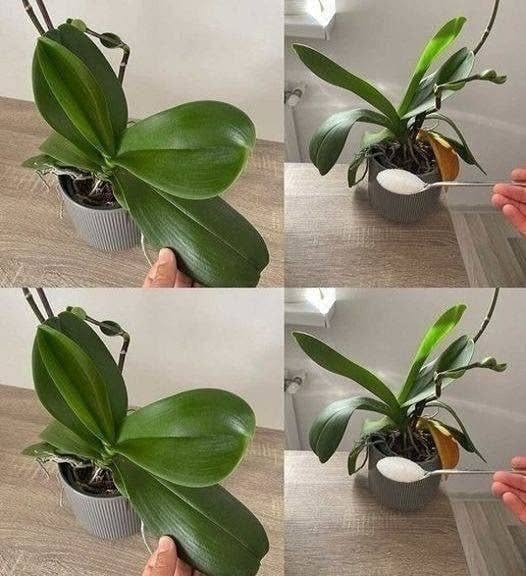
Many articles and videos promote a “miracle orchid fertilizer” with claims such as “just one tablespoon and your orchid will bloom continuously.” In reality, orchid flowering is determined by the plant’s overall health and growing conditions, not by a single application of any fertilizer.
Why orchids bloom—or don’t
Most orchids, especially Phalaenopsis (the common grocery-store orchid), need:
- Adequate light – Bright, indirect light is the most important factor.
- Healthy roots – Green, firm roots absorb water and nutrients efficiently.
- Proper watering – Allow the growing medium to approach dryness between waterings.
- Temperature changes – Many orchids initiate flower spikes when nighttime temperatures are slightly cooler than daytime temperatures.
- Balanced nutrition – Fertilizer supports growth, which in turn supports flowering.
What a fertilizer actually does
Fertilizers provide nutrients, primarily:
- Nitrogen (N): Leaf and stem growth.
- Phosphorus (P): Root and flower development.
- Potassium (K): Overall plant vigor and disease resistance.
A healthy orchid generally benefits more from consistent, moderate feeding than from occasional heavy doses.
If the “one tablespoon” fertilizer is a homemade recipe
Many viral recipes use ingredients such as:
Banana peel fertilizer
Provides small amounts of potassium.
Pros:
- Contains some potassium and trace minerals.
- Easy to make.
Cons:
- Nutrient levels are unpredictable.
- Can attract fungus gnats and mold.
- Does not provide balanced nutrition.
Rice water
Contains trace minerals and starches.
Pros:
- Mild nutrient source.
- Usually safe when used occasionally.
Cons:
- Not a complete fertilizer.
- Fermented rice water can encourage bacterial growth.
Eggshell fertilizer
Provides calcium.
Pros:
- Useful if calcium is deficient.
Cons:
- Orchids rarely need large calcium supplements.
- Calcium alone will not increase blooming.
Coffee grounds
Often recommended online.
Pros:
- May add some organic matter.
Cons:
- Can alter pH.
- May encourage mold.
- Generally not recommended directly in orchid pots.
A proven orchid fertilizing method
Many experienced growers follow the principle:
“Weakly, weekly.”
This means:
- Use a balanced orchid fertilizer (for example, 20-20-20 or a fertilizer specifically formulated for orchids).
- Dilute it to about ¼–½ the recommended strength.
- Apply weekly or every second watering during active growth.
- Flush the pot with plain water occasionally to prevent salt buildup.
Why orchids stop blooming
If an orchid has healthy leaves but no flowers, common causes include:
| Cause | Effect |
|---|---|
| Too little light | Most common reason for no blooms |
| Constant warm temperatures | Flower spikes may not form |
| Overwatering | Root damage reduces flowering |
| Root-bound or decomposed potting mix | Poor nutrient and water uptake |
| Excess nitrogen | Lots of leaves, fewer flowers |
For continuous blooms
No orchid blooms nonstop forever. Even orchids known for long-lasting flowers, such as Phalaenopsis, naturally cycle through:
- Vegetative growth (leaves and roots)
- Spike production
- Flowering
- Rest and recovery
A healthy Phalaenopsis may keep flowers for 2–4 months, sometimes longer, but it still requires a recovery period before blooming again.
A practical routine
- Place the orchid in bright, indirect light.
- Water when the potting medium is nearly dry.
- Fertilize lightly every 1–2 weeks during growth.
- Maintain good air circulation.
- Provide slightly cooler nights in autumn to encourage flower spikes.
- Repot every 1–2 years if the bark medium is breaking down.
This approach is far more reliable than any “one tablespoon miracle fertilizer” and is what experienced orchid growers use to achieve regular, repeat blooming year after year.