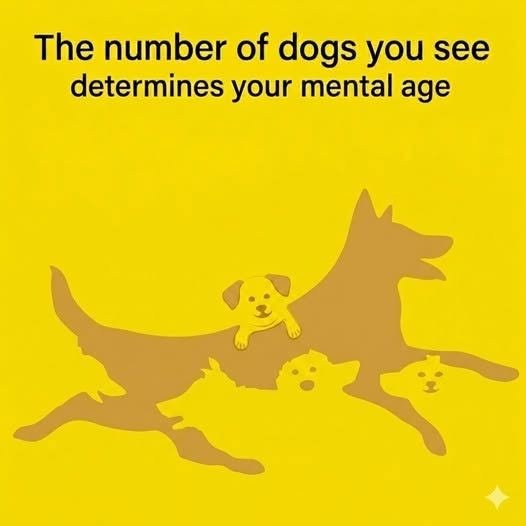
You’ve probably come across it while scrolling:
A slightly confusing image filled with hidden dogs and a bold claim underneath—
“The number of dogs you see reveals your mental age.”
It feels intriguing, almost like a puzzle with a secret psychological meaning. You count carefully, compare answers with others, and suddenly it feels like a personality test.
But in reality, this has very little to do with mental age—and a lot to do with how viral content is designed.
🐶 What these “hidden animal tests” actually are
These images are usually optical illusions or visual puzzles. They are crafted to:
- Hide multiple overlapping shapes
- Trick the eye with shading and outlines
- Create ambiguity so people see different things
Because of this design, two people can genuinely look at the same image and count differently.
🧠 Why people believe it reveals “mental age”
The idea of “mental age” sounds scientific, so it automatically feels credible. But these posts rely on storytelling rather than psychology.
After you submit your answer, you’re usually given results like:
- “You saw 3 dogs → your mental age is 18”
- “You saw 6 dogs → your mental age is 45”
These results are:
- Pre-written
- Not based on actual psychological testing
- Often loosely matched to encourage self-identification
They create the illusion of meaning where there is mostly randomness.
👁️ Why people see different numbers
Your result depends on several real (but non-psychological) factors:
🔍 Visual perception
Some people naturally pick up on outlines faster than others.
⏱️ Attention and timing
The longer you look, the more details you may notice.
📱 Device differences
Screen size, brightness, and resolution can change what stands out.
🧩 Pattern recognition
The brain tries to “complete” shapes even when they’re not clearly defined.
None of this directly relates to mental age.
🧠 What “mental age” actually means in psychology
In real psychology, “mental age” is an outdated concept from early intelligence testing. Modern psychology focuses more on:
- Cognitive abilities
- Problem-solving skills
- Memory and reasoning
- Emotional intelligence
These are measured through structured, standardized assessments—not visual puzzles.
📱 Why these posts go viral anyway
They work because they combine:
- Curiosity (“What do I see?”)
- Competition (“How many did you find?”)
- Identity appeal (“What does it say about me?”)
- Shareability (“Ask your friends!”)
It’s less about accuracy and more about engagement.
🟡 The bottom line
Counting dogs in an image does not determine your mental age. It only reflects how your brain interprets a visual illusion in that moment.
It’s a fun activity, a quick distraction, and a social media trend—but not a psychological measurement.