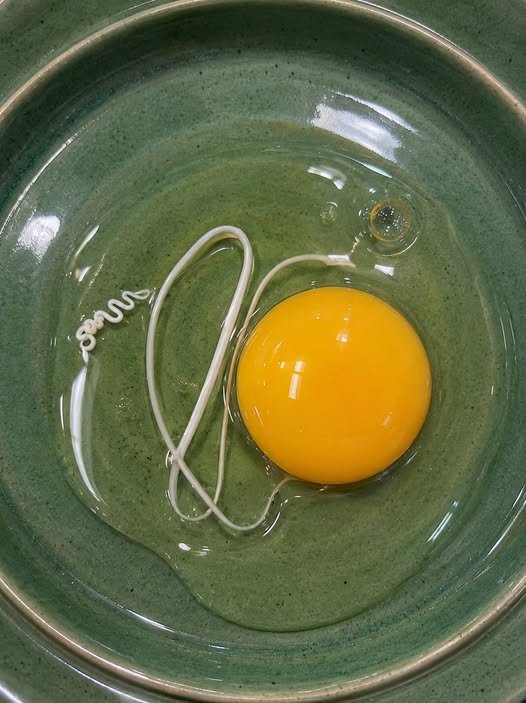
A detailed explanation may help make it look a lot less mysterious.
A detailed explanation may help make it look a lot less mysterious.
What the white ribbon-like thing usually is
The most likely answer is the Chalaza. Every normal chicken egg contains one or two chalazae.
Think of the chalaza as a natural suspension system for the yolk. Inside the egg, the yolk is surrounded by egg white (albumen). The chalazae are twisted strands of protein that connect the yolk to the membranes lining the shell. Their job is to keep the yolk roughly centered and prevent it from bumping around too much.
When you crack an egg onto a plate, these strands can become very noticeable. They often look like:
- A white string
- A ribbon
- A twisted cord
- A piece of tissue attached to the yolk
- A small white “worm-like” structure
Many people who see one for the first time assume it’s a parasite or some kind of defect, but it isn’t.
Why it can look unsettling
The chalaza has a different texture from the surrounding egg white. Most of the egg white spreads out into a clear or slightly cloudy puddle, while the chalaza stays together as a distinct strand.
Because it remains intact, your brain tends to interpret it as a foreign object. That’s especially true when:
- The egg is very fresh.
- The strand is unusually thick.
- It is stretched out on the plate.
- It has a twisted appearance.
A fresh chalaza can easily be a centimeter or more long and look surprisingly substantial.
Why fresh eggs show it more clearly
Fresh eggs contain thicker egg white, and the chalazae are more tightly coiled and prominent.
As an egg ages:
- The egg white becomes thinner.
- The yolk moves more freely.
- The chalazae weaken and become harder to notice.
So seeing a strong, obvious chalaza is often associated with freshness rather than spoilage.
What it looks like compared with other things
Chalaza
- White or off-white
- Attached to the yolk
- Rope-like or ribbon-like
- Firm and stringy
- Safe to eat
Blood spot
- Red, brown, or dark
- Small dot or speck
- Usually found on the yolk
- Not a ribbon or string
Meat spot
- Brown, tan, or reddish fragment
- Small tissue-like piece
- Usually irregularly shaped
Spoiled egg
- Strong sulfur or rotten odor
- Discolored contents
- Unusual appearance throughout the egg, not just a single white strand
Parasite
Parasites in commercial chicken eggs are extraordinarily uncommon. A parasite would generally not appear as a normal white strand attached neatly to the yolk. The vast majority of “white worm in my egg” reports turn out to be a chalaza.
What’s actually happening inside the egg
If you could look inside an intact egg, you’d see something like this:
Shell
 └─ Membranes
     └─ Egg white (albumen)
         └─ Chalaza
             └─ Yolk
         └─ Chalaza
There are usually two chalazae, one on either side of the yolk. When the egg is cracked, you may see one, both, or neither, depending on how the egg breaks.
Can you eat it?
Yes. The chalaza is simply egg protein. It’s completely edible and cooks along with the rest of the egg.
Many people never notice it because:
- It becomes invisible after cooking.
- It blends into scrambled eggs.
- They don’t inspect raw eggs closely.
Professional bakers and cooks encounter chalazae constantly.
If you’re trying to identify what you saw
A chalaza is very likely if:
- The strand was white.
- It was attached to the yolk.
- The egg smelled normal.
- The rest of the egg looked normal.
- The structure resembled a ribbon, cord, or twisted string.
If any of those details don’t match—especially if the object was a different color, detached from the yolk, unusually large, or the egg smelled bad—describe it in more detail or share a photo and I can help narrow it down further.
The most likely answer is the Chalaza. Every normal chicken egg contains one or two chalazae.
Think of the chalaza as a natural suspension system for the yolk. Inside the egg, the yolk is surrounded by egg white (albumen). The chalazae are twisted strands of protein that connect the yolk to the membranes lining the shell. Their job is to keep the yolk roughly centered and prevent it from bumping around too much.
When you crack an egg onto a plate, these strands can become very noticeable. They often look like:
- A white string
- A ribbon
- A twisted cord
- A piece of tissue attached to the yolk
- A small white “worm-like” structure
Many people who see one for the first time assume it’s a parasite or some kind of defect, but it isn’t.
Why it can look unsettling
The chalaza has a different texture from the surrounding egg white. Most of the egg white spreads out into a clear or slightly cloudy puddle, while the chalaza stays together as a distinct strand.
Because it remains intact, your brain tends to interpret it as a foreign object. That’s especially true when:
- The egg is very fresh.
- The strand is unusually thick.
- It is stretched out on the plate.
- It has a twisted appearance.
A fresh chalaza can easily be a centimeter or more long and look surprisingly substantial.
Why fresh eggs show it more clearly
Fresh eggs contain thicker egg white, and the chalazae are more tightly coiled and prominent.
As an egg ages:
- The egg white becomes thinner.
- The yolk moves more freely.
- The chalazae weaken and become harder to notice.
So seeing a strong, obvious chalaza is often associated with freshness rather than spoilage.
What it looks like compared with other things
Chalaza
- White or off-white
- Attached to the yolk
- Rope-like or ribbon-like
- Firm and stringy
- Safe to eat
Blood spot
- Red, brown, or dark
- Small dot or speck
- Usually found on the yolk
- Not a ribbon or string
Meat spot
- Brown, tan, or reddish fragment
- Small tissue-like piece
- Usually irregularly shaped
Spoiled egg
- Strong sulfur or rotten odor
- Discolored contents
- Unusual appearance throughout the egg, not just a single white strand
Parasite
Parasites in commercial chicken eggs are extraordinarily uncommon. A parasite would generally not appear as a normal white strand attached neatly to the yolk. The vast majority of “white worm in my egg” reports turn out to be a chalaza.
What’s actually happening inside the egg
If you could look inside an intact egg, you’d see something like this:
Shell
 └─ Membranes
     └─ Egg white (albumen)
         └─ Chalaza
             └─ Yolk
         └─ Chalaza
There are usually two chalazae, one on either side of the yolk. When the egg is cracked, you may see one, both, or neither, depending on how the egg breaks.
Can you eat it?
Yes. The chalaza is simply egg protein. It’s completely edible and cooks along with the rest of the egg.
Many people never notice it because:
- It becomes invisible after cooking.
- It blends into scrambled eggs.
- They don’t inspect raw eggs closely.
Professional bakers and cooks encounter chalazae constantly.
If you’re trying to identify what you saw
A chalaza is very likely if:
- The strand was white.
- It was attached to the yolk.
- The egg smelled normal.
- The rest of the egg looked normal.
- The structure resembled a ribbon, cord, or twisted string.
If any of those details don’t match—especially if the object was a different color, detached from the yolk, unusually large, or the egg smelled bad—describe it in more detail or share a photo and I can help narrow it down further.