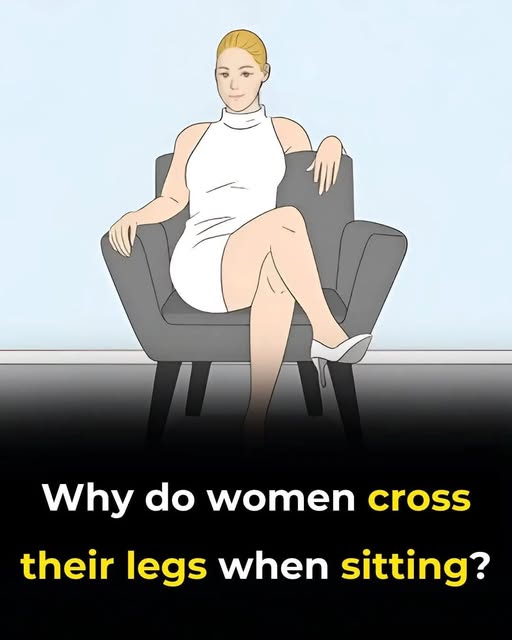
Have you ever noticed that many women naturally cross their legs while sitting? It’s such a common posture that people often assume it has a single explanation—perhaps modesty, femininity, or etiquette. In reality, psychology suggests that there isn’t one universal reason. Instead, leg crossing reflects a combination of comfort, social learning, body language, emotions, culture, and individual personality.
Understanding this seemingly simple behavior offers fascinating insights into human psychology.
The Body Chooses Comfort Before the Mind Notices
The most common reason is surprisingly simple: physical comfort.
Many people—women and men alike—find crossing one leg over the other more comfortable than keeping both feet flat on the floor. The posture can:
- Reduce muscle fatigue while sitting.
- Shift body weight.
- Provide better balance on certain chairs.
- Feel more natural depending on hip flexibility and body proportions.
Women often have slightly wider pelvises and different hip angles than men on average, which may make certain crossed-leg positions feel more comfortable for some individuals. However, anatomy varies greatly from person to person, so this should not be treated as a rule.
Psychologically, our brains favor postures that require the least conscious effort. Once a comfortable position becomes habitual, we repeat it automatically.
Social Conditioning Begins Early
One of the strongest psychological explanations is social learning.
From childhood, many girls receive subtle or explicit messages such as:
- “Sit properly.”
- “Close your knees.”
- “Be ladylike.”
- “Don’t spread your legs.”
These instructions may come from parents, teachers, media, or cultural expectations. Over time, crossing the legs becomes less of a conscious choice and more of an ingrained habit.
Psychologists call this internalized social norms—behaviors that feel natural because they have been reinforced repeatedly.
The result is that many women cross their legs automatically without thinking about why.
Leg Crossing and Modesty
Across many cultures, leg crossing has become associated with modesty.
This is especially true when wearing:
- Dresses
- Skirts
- Short clothing
Crossing the legs can help people feel more covered or secure. In these situations, the posture is often practical rather than symbolic.
The psychology here relates to self-awareness. People adjust their posture when they are conscious of how they may be perceived by others.
Body Language: Creating Personal Space
Psychologists who study nonverbal communication note that body posture often reflects how much space someone chooses to occupy.
Crossing the legs generally makes the body appear:
- Smaller
- More compact
- Less expansive
This doesn’t necessarily indicate low confidence. Instead, it may simply reflect a preference for conserving personal space.
Some people naturally prefer “closed” postures, while others prefer more open ones. Personality, context, and culture all influence these preferences.
Emotional Security and Self-Comfort
Leg crossing can also serve as a subtle form of self-soothing.
When people experience:
- Nervousness
- Anxiety
- Uncertainty
- Social discomfort
they often adopt positions that create a sense of stability.
Crossing the legs provides:
- A feeling of physical containment.
- A stable base.
- Gentle muscle tension that some people find calming.
This is similar to folding the arms or clasping the hands—not necessarily signs of defensiveness, but sometimes ways of regulating emotions.
Confidence Can Look Different
Popular body-language books sometimes claim that crossed legs always signal insecurity.
Modern research paints a more nuanced picture.
A woman may cross her legs while:
- Leading a business meeting.
- Giving a university lecture.
- Negotiating a contract.
- Speaking confidently on stage.
In these situations, the posture reflects comfort or habit rather than insecurity.
Psychologists caution against interpreting any single gesture in isolation. Body language is best understood by considering the full context, including facial expressions, tone of voice, movement, and the situation.
Cultural Expectations Matter
Body language is deeply influenced by culture.
In some societies:
- Crossing the legs is considered polite.
- Sitting with knees together is expected.
- Wide-legged sitting is viewed as inappropriate for women.
In other cultures, these expectations are much less pronounced.
What feels “natural” often reflects years of observing others and adapting to local social norms.
The Influence of Clothing
Fashion quietly shapes posture.
Women wearing:
- Pencil skirts
- Formal dresses
- High heels
may find crossed-leg sitting more comfortable or practical.
Even after changing into casual clothing, the habit may persist because it has become automatic.
Psychologists refer to this as habit formation—repeated behaviors that become default patterns.
Personality Differences
Personality also influences sitting posture.
People who are:
- Introverted
- Reserved
- Reflective
may naturally adopt more compact sitting positions.
Meanwhile, individuals who are:
- Highly expressive
- Extraverted
- Relaxed
may occupy more physical space.
However, these are tendencies, not reliable indicators. Personality cannot be accurately inferred from a single posture.
Context Changes Everything
The same woman may sit differently depending on where she is.
For example:
At home
- Legs stretched out.
- Sitting cross-legged on the couch.
- Relaxed posture.
At work
- Legs crossed neatly.
- Upright posture.
- Professional appearance.
With close friends
- Casual, varied positions.
During an interview
- More controlled posture due to self-awareness and the formality of the setting.
Psychologists emphasize that body language is highly context-dependent.
Is It a Sign of Attraction?
Some people believe crossed legs always indicate romantic interest.
The evidence does not support this.
In some cases, a person may angle crossed legs toward someone they are engaged with, but leg crossing by itself is not a reliable sign of attraction.
Interpreting attraction requires considering many signals together, such as:
- Eye contact.
- Facial expressions.
- Smiling.
- Conversation style.
- Physical orientation.
- Overall behavior.
No single posture provides a definitive answer.
Does It Mean Someone Is Defensive?
Not necessarily.
A crossed-leg posture can reflect:
- Comfort.
- Habit.
- Modesty.
- Temperature (keeping warm).
- Formal etiquette.
- Emotional regulation.
- Limited seating space.
Without additional context, it’s not possible to conclude that someone is defensive or closed off.
Why Is This Behavior More Commonly Noticed in Women?
Several factors likely contribute:
- Social expectations often encourage women to sit with their knees together or legs crossed.
- Certain clothing styles make crossed-leg sitting more practical.
- Repetition over many years turns the posture into an automatic habit.
- Cultural ideals about femininity have historically emphasized smaller, more contained body postures.
At the same time, many men also cross their legs, and many women do not. There is considerable variation across individuals and cultures.
The Psychology Behind a Simple Habit
What appears to be a simple sitting position is actually shaped by multiple influences working together:
- Biology: Individual anatomy and comfort.
- Learning: Habits developed through repetition.
- Culture: Social norms about posture and etiquette.
- Emotion: A sense of stability or self-comfort.
- Context: Different environments encourage different postures.
- Personality: Individual preferences in occupying space.
No single explanation fits everyone.
Final Thoughts
Crossing the legs is one of those everyday behaviors that seems insignificant until examined more closely. From a psychological perspective, it illustrates how our bodies reflect an interplay of comfort, social learning, culture, emotion, and context. Rather than being a reliable indicator of confidence, insecurity, modesty, or attraction on its own, leg crossing is best understood as a flexible, often unconscious behavior whose meaning depends on the individual and the situation.
The key takeaway is that body language should rarely be interpreted through a single gesture. Human behavior is complex, and the most accurate understanding comes from looking at the broader pattern of actions, environment, and social context rather than relying on one posture alone.