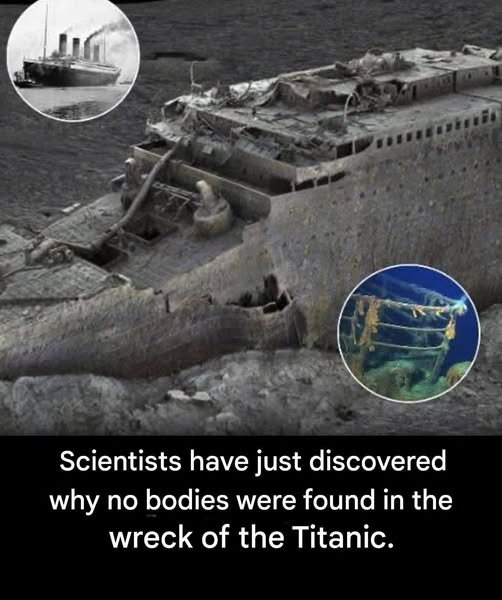
When the wreck of the RMS Titanic was discovered in 1985, one of the biggest questions people asked was: “Where are the bodies of the 1,500+ people who died?” Many expected to find human remains inside the ship, but explorers found only personal belongings, shoes, clothing fragments, and parts of the ship.
The reason is a combination of time, ocean conditions, and natural decomposition.
1. The Titanic Sank in Extremely Deep Water
The Titanic lies about 3,800 meters (12,500 feet) beneath the North Atlantic Ocean.
At this depth:
- The water temperature is close to freezing (around 1–4°C).
- Pressure is hundreds of times greater than at the surface.
- Sunlight does not reach the wreck.
- The environment is very different from normal land burial conditions.
Although cold water slows decomposition, it does not preserve a body forever.
2. Bodies Were Exposed to the Ocean After the Sinking
When the Titanic sank on April 15, 1912, many passengers and crew members were trapped inside the ship, while others died in the freezing ocean.
Those who remained in the water were quickly affected by:
- Extremely cold temperatures
- Ocean currents
- Marine animals
- Natural decomposition
Many bodies that floated on the surface were later recovered by rescue ships.
3. Deep-Sea Creatures Removed Soft Tissue
After death, the human body naturally breaks down. In the deep ocean, this process is helped by:
- Bacteria
- Small marine organisms
- Scavengers
Over decades, soft tissues such as skin, muscles, and organs disappear.
4. Why Didn’t the Bones Remain?
Many people assume bones should still be there, but deep-sea conditions can also destroy skeletal remains.
The water around the Titanic is not ideal for preserving bones because it can slowly dissolve minerals from them. Over more than 100 years, bones can break down and disappear.
5. Why Are Shoes Sometimes Seen Near the Wreck?
Explorers have photographed pairs of shoes lying on the ocean floor near the Titanic.
These shoes are believed to be from areas where bodies once came to rest. Leather shoes can survive much longer than human tissue because they are made from treated materials that break down more slowly.
The shoes are not proof that bodies are still there—they are evidence that human remains were once present.
6. Many Bodies Were Recovered After the Disaster
After the Titanic sank:
- Rescue ships searched the area.
- Hundreds of bodies were recovered.
- Many victims were buried at sea because ships had limited space and resources.
Some victims were returned to families, while others were buried in cemeteries in places such as Halifax, Canada.
7. The Wreck Was Not Opened Like a Tomb
Another reason is that the Titanic wreck is spread across a large area. The ship broke apart during the sinking, creating a debris field miles long.
Even if some remains had survived initially, they would have been scattered and exposed to the ocean environment.
8. The Titanic Is Considered a Maritime Memorial
Today, the Titanic wreck is treated as a final resting place for those who died. Scientists and explorers generally avoid disturbing the site unnecessarily out of respect for the victims.
Final Answer
No bodies were found at the Titanic wreck because more than 100 years of deep-ocean conditions caused human remains to disappear. Cold water slowed the process, but bacteria, marine life, chemical changes in seawater, and the passage of time eventually destroyed the bodies. The shoes and personal items found at the site are reminders that people were once there, even though their physical remains are no longer visible.