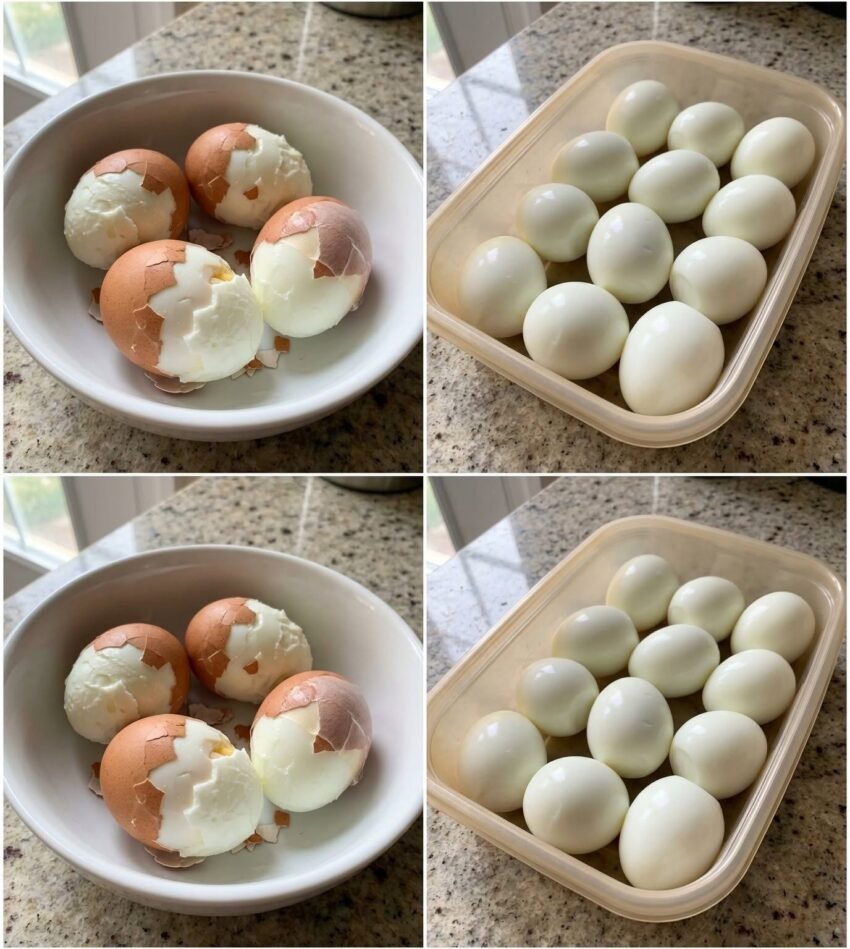
If you’ve ever stood over the kitchen sink peeling a hard-boiled egg only to end up with half the egg sticking to the shell, you’re not alone. It’s one of those everyday frustrations that seems impossible to avoid. You crack the shell carefully, start peeling with confidence, and within seconds you’re left with a lumpy egg covered in tiny shell fragments.
That exact thing happened to me one morning while making egg salad. My friend happened to be visiting, and after watching me struggle for several minutes, he burst out laughing.
“Seriously? You don’t know the trick?”
I looked at him in confusion.
He’s a professional chef, so I assumed he was about to reveal some complicated culinary secret. Instead, he shared one incredibly simple technique that changed everything. Now my hard-boiled eggs peel beautifully almost every single time, and I can’t believe I spent years doing it the hard way.
Here’s the surprisingly easy trick.
Why Hard-Boiled Eggs Are Sometimes Impossible to Peel
Many people assume they’re cooking the eggs incorrectly, but that’s usually not the problem.
Several factors affect how easily an egg peels:
- The age of the egg
- Cooking temperature
- Cooling method
- The membrane between the shell and the egg white
Fresh eggs are actually the hardest to peel because the membrane clings tightly to the egg white. Slightly older eggs—around one to two weeks old—generally peel much more easily.
The Chef’s Secret: The Ice Bath
The biggest game-changing trick isn’t adding mysterious ingredients or buying expensive gadgets.
It’s simply placing the eggs into an ice bath immediately after cooking.
Here’s how:
- Bring water to a gentle boil.
- Carefully lower the eggs into the boiling water.
- Cook for:
- 9 minutes for slightly creamy yolks
- 10–12 minutes for fully firm yolks
- Meanwhile, fill a large bowl with ice and cold water.
- As soon as the eggs finish cooking, transfer them directly into the ice bath.
- Let them sit for at least 10–15 minutes.
The sudden temperature change causes the egg to contract slightly, separating it from the shell and making peeling dramatically easier.
Another Trick Most Home Cooks Skip
After cooling, gently crack the egg all over.
Instead of peeling from the middle, start peeling from the wider end of the egg.
Why?
The wider end usually contains a tiny air pocket. Once you get underneath that membrane, the shell often comes off in large pieces instead of dozens of tiny flakes.
The Rolling Method
One of the quickest techniques is incredibly satisfying.
Simply:
- Place the cooled egg on the countertop.
- Roll it gently under your palm.
- Apply light pressure until the shell develops small cracks all around.
- Peel under cool running water.
The water slips beneath the membrane and helps lift the shell away effortlessly.
Should You Add Baking Soda?
Many people swear by adding baking soda to the cooking water.
The theory is that it raises the water’s pH, making the shell separate more easily.
While some home cooks notice a difference, food experts generally agree that an ice bath and using slightly older eggs have a much greater impact.
If you want to experiment, add about ½ teaspoon of baking soda per liter (quart) of water.
What About Vinegar?
Another popular kitchen tip is adding white vinegar to the boiling water.
Vinegar won’t necessarily make peeling easier, but it can help if an egg cracks while cooking by encouraging the egg white to coagulate more quickly, reducing leakage.
Don’t Skip the Cooling Time
Many people are impatient and start peeling while the eggs are still warm.
That’s often why the shell sticks.
Allowing the eggs to cool completely gives the membrane time to separate from the egg white, making peeling far easier.
How Long Should You Boil Eggs?
The perfect cooking time depends on your preferred yolk texture.
| Texture | Cooking Time |
|---|---|
| Soft-set | 6–7 minutes |
| Jammy | 8–9 minutes |
| Firm but creamy | 10 minutes |
| Fully hard-boiled | 11–12 minutes |
Remember that larger eggs may require an extra minute.
Common Mistakes That Make Peeling Harder
Avoid these common errors:
- Using extremely fresh eggs
- Skipping the ice bath
- Peeling while the eggs are still hot
- Starting from the pointed end
- Overcooking the eggs, which can create a green-gray ring around the yolk
How to Store Hard-Boiled Eggs
Once cooked, hard-boiled eggs can be safely stored in the refrigerator for up to one week.
For best freshness:
- Keep them in their shells until you’re ready to eat them.
- Store them in a covered container.
- Refrigerate promptly after cooling.
Final Thoughts
Sometimes the best kitchen tips are also the simplest. While countless internet hacks promise perfectly peeled eggs, the combination of using slightly older eggs, transferring them immediately into an ice bath, and peeling from the wider end consistently delivers the best results.
It’s one of those techniques that’s so easy you’ll wonder why you didn’t try it years ago. The next time you’re preparing deviled eggs, egg salad, or a quick protein-packed snack, this simple method can save time, reduce frustration, and leave you with smooth, beautiful hard-boiled eggs every time.