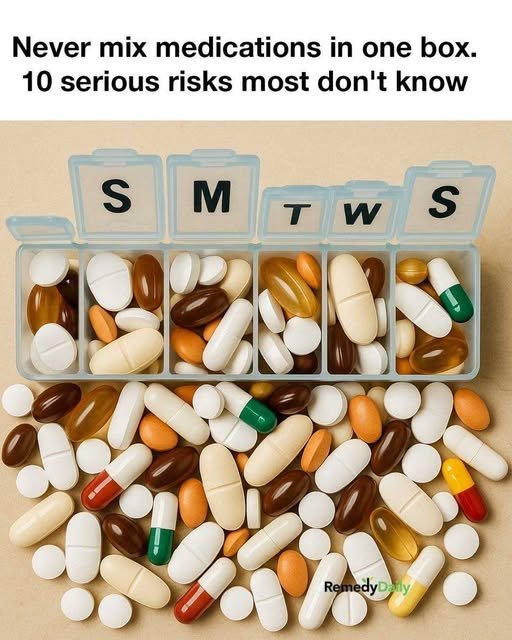
Storing multiple medicines together in one box might seem harmless—just a space-saving habit or a way to stay organized. But in practice, it can quietly create serious risks that many people only realize after something goes wrong. Medications are not like ordinary household items; they are chemically sensitive, time-dependent, and often look deceptively similar.
Here are 10 serious risks of mixing medications in one container, explained in a clear, real-world way.
1. Accidental wrong medication intake
When tablets and capsules are all in one box, it becomes easy to grab the wrong pill—especially if you’re in a hurry or taking medication in low light. Many drugs look similar in size, shape, and color. A single mistake can lead to missed treatment or harmful overdose.
2. Dangerous drug interactions go unnoticed
Some medications are safe on their own but risky when taken together at the wrong time or dose. When everything is mixed, it becomes harder to track which medicine should be taken with what schedule, increasing the chance of accidental interactions.
3. Loss of labeling and identity
Once medicines are removed from their original packaging, important details are lost—drug name, strength, expiry date, batch number, and instructions. Without these, you are essentially relying on memory, which is unreliable over time.
4. Expired medicines get mixed with active ones
In a shared box, expired tablets don’t stand out. People often unknowingly consume outdated drugs, which may be less effective or, in some cases, chemically unstable.
5. Moisture and heat damage increases
Original blister packs and bottles are designed to protect medicines from humidity and light. When removed and stored loosely, they degrade faster—especially in warm or humid climates. This can reduce potency without any visible sign.
6. Child safety risks increase
Child-resistant packaging is specifically engineered for safety. Loose storage removes this layer of protection, making accidental ingestion by children far more likely and far more dangerous.
7. Confusion in emergency situations
In a medical emergency, doctors or paramedics need to quickly know what medications a person is taking. A mixed box makes it difficult or impossible to identify drugs accurately, delaying critical treatment decisions.
8. Incorrect dosing due to similar appearance
Many tablets from different brands or even different drugs can look nearly identical. Without original packaging, it becomes easy to confuse strengths (e.g., 5 mg vs 10 mg), which can lead to underdosing or overdose.
9. Reduced effectiveness from contamination risk
Loose storage can expose tablets to dust, air, or contact with other medications. In rare cases, coatings can rub off or pills can degrade faster when stored improperly together.
10. Medication adherence becomes harder to track
When everything is mixed, it becomes difficult to confirm whether a dose has been taken or missed. This often leads to double-dosing or skipped doses, especially for long-term treatments like blood pressure or diabetes medication.
Final thought
A simple habit like mixing medicines in one box might feel convenient, but it removes safety layers that pharmacists and manufacturers carefully build in. The original packaging is not just for branding—it’s part of the medicine’s protection system.
If organization is the goal, a better approach is using a labeled weekly pill organizer or keeping each medicine in its original blister pack while storing them in a dry, clearly separated container.
If you want, I can rewrite this into a more SEO-friendly blog post, or adapt it for social media captions or a carousel post.