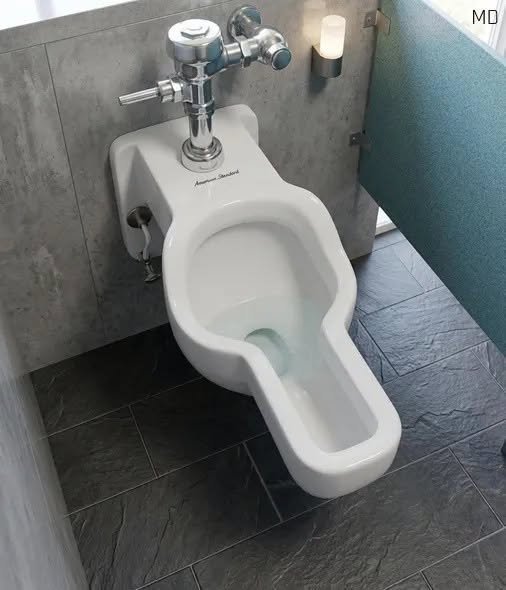
At first glance, it looks like an ordinary toilet—until you notice the unusual shape of the seat. Photos of oddly designed toilets often go viral online, leaving people wondering whether they’re futuristic inventions, accessibility features, or simply design mistakes.
One image that has sparked plenty of curiosity was reportedly taken in a women’s restroom at the U.S. Space & Rocket Center in Huntsville, Alabama. The toilet’s unusual design prompted countless questions, with many people asking, “Why would anyone make a toilet like this?”
As it turns out, there’s a practical explanation.
The Unusual Shape
Unlike a traditional round or elongated toilet seat, this design appears to have an open or differently contoured front section. While it may seem strange at first, similar designs are used in many public restrooms around the world.
Rather than being decorative, the shape serves specific hygiene and accessibility purposes.
A More Hygienic Design
One of the primary reasons for an open-front toilet seat is improved hygiene.
The gap at the front helps:
- Reduce contact between the user and the seat.
- Make it easier to wipe and clean after use.
- Decrease the chance of urine collecting on the front of the seat.
- Allow custodial staff to clean the toilet more efficiently.
Because fewer surfaces are touched, these seats are commonly installed in high-traffic public facilities.
Common in Public Buildings
Although they may seem unusual to people accustomed to residential toilets, open-front toilet seats are widely used in:
- Airports
- Shopping malls
- Schools
- Hospitals
- Restaurants
- Government buildings
- Museums
- Visitor centers
Many commercial building standards and plumbing codes favor this style for public restrooms because of its practical advantages.
Accessibility Considerations
Some specially designed toilet seats also improve accessibility by making transfers easier for individuals with certain mobility limitations. However, not every open-front seat is specifically intended as an accessibility feature.
Restrooms that comply with accessibility standards often include additional features such as:
- Grab bars
- Extra maneuvering space
- Appropriate seat height
- Accessible sinks and fixtures
These features work together to make public restrooms safer and easier to use.
Is It Related to Space Technology?
Because the photo was reportedly taken at the Huntsville Space Center, many people assume the toilet has something to do with astronauts or spacecraft.
In reality, the unusual seat is not a space toilet. Public restroom fixtures in museums and visitor centers are generally the same commercial models used in many other buildings.
Actual toilets used aboard spacecraft are highly specialized systems that rely on airflow and vacuum technology rather than gravity to manage waste in microgravity—completely different from standard public restroom toilets.
Why the Design Looks So Different
People often notice the seat because it differs from what they have at home. Residential toilets usually feature fully enclosed seats designed for comfort, while commercial restrooms prioritize:
- Durability
- Easy maintenance
- Improved hygiene
- Reduced cleaning time
- Long-term reliability
The result is a design that may look unfamiliar but serves a practical purpose.
Frequently Asked Questions
Why are some public toilet seats open at the front?
The open-front design can improve hygiene, reduce contact with the seat, and make cleaning easier in busy public restrooms.
Are open-front toilet seats required?
In many jurisdictions, plumbing codes or commercial building standards recommend or require open-front seats in public restrooms, though specific requirements vary by location.
Is this a special toilet for astronauts?
No. Despite being located at a space-related facility, the restroom typically uses standard commercial plumbing fixtures. Spacecraft toilets use entirely different technology designed for zero gravity.
Are these toilets more sanitary?
While no toilet is completely germ-free, the design can reduce certain types of contact and make routine cleaning more effective, which may contribute to better hygiene in public settings.
Final Thoughts
The unusual toilet seat seen in the women’s restroom at the Huntsville Space Center isn’t a futuristic invention or a secret piece of space technology. Instead, it’s a practical commercial design intended to improve hygiene, simplify cleaning, and accommodate the demands of high-traffic public restrooms.
Sometimes the most puzzling designs have the simplest explanations—and in this case, what looks unusual is actually a common feature found in public buildings across many parts of the world.
Disclaimer: Building codes and restroom fixture designs vary by country and region. The information in this article is intended for general educational purposes and may not apply to every public facility.